Movies, Theatre

From the archives: Equus in London, March 2007

Intending to write a commentary about Daniel Radcliffe’s recent film What If, I instead found myself recalling when I saw him perform live onstage at the Gielgud Theatre in London, in a role that drew significant media attention. Thankfully, I wrote about the performance on LiveJournal a few days later…

This production lives up to the hype, in nearly all elements. Coming into the Gielgud Theatre with a significantly better seat than when I saw Frost/Nixon, I was immediately struck by the scope of the set. A plain proscenium stage had been turned into an almost theatre-in-the-round style area, with a central elevated level that could be turned if needed surrounded by openings off stage, symbolizing stable doors, and also, perhaps, different tracks of life from which Alan and Dysart could proceed onto when the show concluded. There were also audience members seated above the stage in a semi-circle to continue the effect of observation. Lighting design stood out from the beginning, as the show opened with Radcliffe proceeding centre stage with one of the horses (actually a performer in costume with a large head of a horse) and being symbolically isolated from all, just a kid and his horse.

Richard Griffiths came onstage as soon as the play began and almost never went off, requiring great concentration on his and the audiences parts. But he succeeded in so many ways, stepping in front of Radcliffe’s press-attention (as other reviewers have noted) to deliver a complex portrayal of Martin Dysart, sympathetic psychotherapist. In Griffiths’ hands, Dysart became a warm filter, or magnifying glass, through which the audience could observe and comment on the actions of the play. He also conveyed Dysart’s shifting motivations and impassions over the course of the story. Initially he was eager to take on a new client and thought that he could relatively easily break through to Alan, leaving the job done and the Strang family reunited together again. But in the reality of the narrative, Dysart only continues to be more and more buried in his work, developing more and more distance from what little home life he has and throwing himself into talking with his clients. This predicament was both noble and tragic, and Griffiths’ slightly remorseful line inflictions highlighted his character’s personal challenges throughout the show.

Daniel Radcliffe deserves enormous kudos for being bold enough to step out of the Harry Potter typecasting into a role so different from what his fans (and critics) are accustomed to seeing him in. He almost completely pulled off the part, in my opinion. I’m sure that he could project from experience in the early scenes of Alan demonstrating his jaded-teenagerdom life and his disdain for his family and friends. However, the characterization often seemed to end there. When Alan was supposed to be younger, or more intimate with his friends and family, Radcliffe continued to speak in a forceful tone (not quite a monotone, more of a vocal strain) that showed his built up anguish, but not his scared-ness beneath that anxiety. I wanted to see him dive deeper into the psychological problems that Alan faces. However, I suspect (or hope) that his character investigations might continue as the show’s run goes along. He remained completely committed and in the moment with the stage actions, especially in the scenes that are causing the most controversy. Also, the relationship between him and Richard Griffiths was strongly balance – counterbalanced in their scenes together. At the curtain call it was clear that they are dependent on each other but enjoying the process, as they preceded centre-stage with their arms around each other, like a grandparent-grandson relationship might be.

The rest of the cast was somewhat victimized by the thinly-drawn nature of the supporting characters in the script. However, Jenny Auggiter (as the magistrate), Joanna Christie (as Alan’s girlfriend), and Jonathan Cullen (Alan’s dad) all invested meaningful levels of psychological realism in their portrayals. All three of them carefully balanced a level of character inquiry and being in the moment with a full awareness that in reality there would not be a clear, immediate resolution to the plot.

In conclusion, this version of Equus is a compelling evening of theatre. Although it’s not quite as good as the hype machine may have lead you to believe, it certainly lives up to the publicity, and Griffiths’ and Radcliffe’s double-act stands high as a professional theatre example of actorly collaboration and rich investment in full dramatic art.


Standard
Movies, Theatre

The music brings me back to the Playhouse

As part of an extended stay back on my family homeland of Martha’s Vineyard, I was excited to attend a show at the Vineyard Playhouse, the island’s resident professional theatre, for the first time in several years.

playhouse

This show, Search: Paul Clayton, took a historical docudrama look at an individual who was involved with Bob Dylan’s early career and genesis as a musician. Sadly, Clayton committed suicide in 1967 at the age of 36. He had humble beginnings here in Massachusetts (New Bedford) and then developed an affinity for the state of Virginia after attending school in the Charlottesville area. Later, he migrated for New York City and the early days of the folk music movement, where he remained until his untimely death.

The story focuses on Clayton’s music and some personal entanglements in a manner reminiscent of the recent film Inside Llewyn Davis. However, this story is ultimately told in a more upbeat way, in spite of Clayton’s personal difficulties and challenging social relationships. We meet his parents, briefly, a few of his New York acquaintances, and most importantly, the young singer Bob Dylan, played with winsome charm by Jared Weiss. Peter Oyloe as Clayton shifts back and forth between a narrator role and embodying Clayton. The show also includes a nod to the digital media age (I assume that’s how it was intended) in an early sequence using computer projected images and a digitized voice. The projection elements contribute to the story for about three-quarters of the show, most notably in a back projected road trip sequence.

While I sometimes have mixed opinions about musicals, this one moved right along, for the most part, and was carried by the commitment of its actors and uniqueness of the staging, with minimal props and a simple proscenium stage. It seems to be an excellent way for the recently renovated Playhouse to show off their new capabilities and facilities following a renovation.

I might have enjoyed it more if the songs all contributed to the advancement of the story (some did and some didn’t) and if the script chose to end at the downbeat suicidal moment, which is portrayed on stage. The ensemble demonstrates a tight cohesion in their musical performances, and some members slip in and out of different characters, which was entertaining if not always clear. Special credit must be given to Jaime Babbitt for a gusto-filled performance which she wasn’t shy of enlivening with a classic New York accent.

_______________

Music was also a central theme of the late – summer blockbuster Guardians of the Galaxy, which I caught with a friend in Maine at the beginning of this week. The film followed a familiar template origin story for its ragtag band of heroes, and it’s inevitable that a sequel will soon appear for the team. However, I’m not sure I’ve ever seen a big studio film that took such an unusual approach to incorporating music into its plot, and I’m sure that will stand out the most in my memory of the film.

Standard
Movies, Theatre

Saturday Night Doubleheader

It felt like my old days of Bay Area arts-going as I enjoyed a live performance followed by a film in close proximity to each other (and walking distance from my apartment!) in downtown Ann Arbor this evening.

First up was an Ann Arbor Summer Festival kick-off appearance from Ms. Lily Tomlin – a Michigan native and (obviously) esteemed performer who does not act or present like the stereotypical/imagined 74 year old. Tomlin seemed to relish being onstage, frequently walking around with her hands outstretched like a very dedicated power walker, and easily slipping in, vocally and physically, to various characterizations from her catalogue. She also incorporated several video segments into her monologue, mixing a bit of older excerpts with some material that may have been conceived especially for this show. Perhaps most impressively, she delivered her whole 90 minute set as an extended monologue, barely pausing for breath on a handful of occasions and never needing to look at a card or any sort of prompt.

While I enjoyed the opportunity to see a legend like Ms. Tomlin onstage, I didn’t feel 100% connected to her material and felt that I might not be in the intended age range and/or demographic that she is gearing towards. I don’t hold that against her at all and am grateful for the chance to see her live, as she always has projected intelligence, fun and good humor in the various television and film projects I have seen her in over the years.

On my way back towards my apartment from Hill Auditorium, I noticed that my erstwhile favorite art house, The State, had some new films on the lineup, including Cold in July, which happened to be starting its late show right when I was in front of the cinema. So I ventured inside.

cold in julyThis film oozes Texas character, and at times seems like a sibling to No Country for Old Men as it tracks another trio of Lone Star State characters seeking vengeance for mysterious – and not clear until the final reel – acts. It is also based on a book, though I had not heard of the title.

Subtlety is the name of the game as the plot unspools, with Michael C. Hall in the central role projecting resoluteness alternating with uncertainty. He is strongly supported by older veterans Sam Shepard, who needs no introduction but really shines here after window-dressing in his August: Osage County cameo appearance, and an initially unrecognizable Don Johnson poking fun at his suave reputation, and then going deeper as the story goes on. Up and coming celebrity progeny Wyatt Russell makes an appearance late in the film as a key character, and isn’t given much to do or say, but projects strong screen presence. Character actress Vinessa Shaw gets the major female role, and while unfortunately she isn’t given much to do, she continues to demonstrate an intelligent screen presence that I first noticed way back in Hocus Pocus.

The familiar plot concerns the ricochet effects that happen to Hall and Shaw and their son after Hall suddenly shoots an intruder in their home late one night. The first quarter of the film covers standard police procedural territory, and then things turn more interesting after that, leading to a predictable, though well thought out explosive finish. The story doesn’t really tie up all of its initial loose ends, but it seems to be more concerned with the mood and impact of the violence. I guess that means more realism, and some of the scenes – and Hall’s remorse and uncertainty alternating with resolve – recall the recent Blue Ruin.

Technical elements of the film are solid if not outstanding, with the most detail seemingly on the 1989 period setting. Fitting in with the subtlety, and possibly low budget, I liked that most of the elements were suggested rather than fully realized, such as old cars tooting around the dusty Texas town, a night drive to the Houston area with only a distant highway sign giving a sense of place, and the finale initially beginning offscreen, but audible, and the main character moving into the forefront of the action. I could have done without, or preferred a different, music score from the at times heavy-handed cues that were used, emphasizing classical music and speaking for some of the character motivations in place of dialogue. I appreciated the act by act structure of the plot, in that it was well defined, and again feel that morality tales such as these are great fits for late shows on a Friday or Saturday night.

Standard
Theatre

Sudden End of an era in the South Bay Area

Today San Jose Repertory Theatre announced that it has filed for bankruptcy and will no longer produce shows or any output, immediately canceling the remainder of its season and its planned 2014-15 offerings.

Although I never made it to see a show there, I was familiar with its output as a notable producer of plays in the South Bay region. Additionally, I had worked with its now-former artistic director, Rick Lombardo, in the Boston area, and he and I actually made the move to California at the same time, though bound for different locations.

It’s a shame – and seems quite incredulous, actually – that the Rep couldn’t form an alliance with one of the deep – pocketed tech companies in the Silicon Valley area. I don’t know the whole story, of course, though it may be tied in to downtown San Jose’s ups and downs with making itself into a destination rather than just a place that people work. I applied to work there at least once between 2008 and 2011, though it was always just a little too far from my Marin County home base to go for a night. However, many regional actors based more in the central Bay Area (SF, Oakland, Berkeley) appeared there regularly in a variety of shows and roles.

There are uncomfortable parallels with a similar situation unfolding here in Ann Arbor at the moment with the city’s premiere resident theatre company, Performance Network, although in that case the organization’s board has “suspended operations” and a new business model is set to be presented to the board at their upcoming meeting next week.

And on a personal note, this news comes just as I’ve been accepted to study for an MFA at an arts management program. But I remain committed and hopeful that the power of the arts as a beacon of the community – and way for people and places to come together – will shine through.

Standard
Theatre

Belated impressions of a Philadelphia premiere

There are just a few days left to catch Annapurna at Theatre Exile, and for some reason probably connected to my travel itinerary, I did not write it up here after attending the April 20 preview performance.

annapurnagal9

Actors Pearce Bunting and Catharine Slusar, pictured above, truly shine in this play, and I was very surprised to learn they had not worked together before, though they have likely crossed paths in the Philadelphia theatre community. I was interested to learn that the play premiered at San Francisco’s Magic Theatre shortly after I left the Bay Area in 2011 and also enjoyed a concurrent New York run this spring with the starry team of Megan Mullaly and Nick Offerman, as The New York Times highlighted prior to that production’s opening. Additionally, I had seen one prior production of the playwright’s work, and wish that I had seen another, and felt that this script offered a more mature and seasoned writing style than the earlier pieces.

In Philadelphia the setting is (presumably) more intimate from the bright lights of Off Broadway. Anything can happen in Theatre Exile’s versatile Studio X space, nestled in to the character – filled and city – wise South Philadelphia neighborhood. This time, the studio was evenly divided between an expansive set, designed by Thom Weaver, and the audience assembled on risers, with the stage management booth beyond that. The noticeably detailed and artfully strewn set evoked curiosity from the first moments of the play, with screen doors, a running shower and faucet, a bed, and several cabinets all contributing to the strong impression of Ulysses (Bunting) living an isolated life on a Colorado mountain.

A brief slapstick introduction, when Ulysses can’t believe that his wife Emma (Slusar) suddenly reappears after a 20 year absence and no contact whatsoever, gives way to a quick shift into a strand of mystery-based drama, as Emma’s motivations for coming to visit become more apparent, though never explicitly spelled out, and we learn more about Ulysses and his choices to live in isolation and face a terminal illness.

It sounds a little bit “movie of the week” cheesiness as I describe the plot there, but the reality of the tale was much more gripping. Aided by Joe Canuso’s tight and specific direction, the two actors subtly juggled power dynamics and held the audience’s attention through the 90 minutes or so of the play, which is not always an easy thing to do. As well, the plot continues to slowly unravel in such a way that the Big Revelation could be considered the start of a wider contemplation and reflection that continues after the lights have gone down on the show.

It was great to “touch in” again with the work of Theatre Exile, where I spent an intense two months working on A Behanding in Spokane exactly two years ago. I was happy to see a healthy audience crowd in place for that Easter Sunday matinee, with a noticeable (and welcome) diverse age range visible, and know that the play has matured even further as it moves towards a sure to be strong finish this Sunday, May 11.

Standard
Movies, Theatre

Don’t shoot her

elaine372Versatile and legendary actress Elaine Stritch first came to my attention in a somewhat unmemorable role (for her – as I learned later) in the 1997 comedy Out to Sea, part of a series of films that comedy legends Jack Lemmon and Walter Matthau made together near the end of their careers, and sadly, lives. In a classic eye roll inducing example of Hollywood casting, Stritch portrayed Dyan Cannon’s mother, even though the actresses are only 12 years apart in real life. Stritch commanded the screen in her few scenes, most notably tearing up a rug with fellow veteran Donald O’Connor to a cheesy rendition of “Sea Cruise.”

At some point in the next couple of years I became aware that Stritch is, in fact, a legendary stage actress, arguably best known for originating a role in Company by Stephen Sondheim but boasting many other accomplishments. As a theatre professional I recall noticing that her most recent Broadway appearance, starring in A Little Night Music with Bernadette Peters, was perhaps more successful than the original revival marquee pairing of Catherine Zeta – Jones and Angela Lansbury.

In the present day, Stritch has slowed down, somewhat, and departed her longtime home base of New York City for a new/old home right here in the state of Michigan, where she was born and lived until her late teen years. It seems that old age (she’s now 89) and health have caught up with her, although, on the other hand, she also seems to be a textbook study in “never say never.”

And so the documentary film Elaine Stritch: Shoot Me is making the rounds at cinemas around the country. I first heard about this film well over a year ago and found the actual experience of seeing it to be somewhat anticlimactic for that reason. I also may have been feeling some residual annoyance that I did not attend its Michigan premiere over in Birmingham last month, for which Ms. Stritch was also in attendance.

The film takes an unflinching look at Stritch’s life circa 2011 – 2012, as she continues to perform mostly in cabaret settings, struggles with problems related to the aging process, begins to tire of life in Manhattan and (somehow) maintains a resiliency that “the show must go on” – to use a cliched but true phrase. Stritch demonstrates resiliency, commitment and salty enthusiasm in all of her projects, perhaps most notably in her balance of masking her difficulty in memory into a sort of comedic act with her musical director when they are performing… to the audience’s delight.

I found the scenes where Stritch was at her most genuine to be the most appealing. These moments took the form of when she was with family members or close friends. There she was as a veteran and accomplished performer earning her accolades but also going with the flow and not getting too worked up about something not going right, a deadline or an impending decision that had to be made. It seemed those moments, with her broad and genuine smile and satisfaction, showed her at her most honest.

Ms. Stritch has been vocal about a seemingly and understandably rough transition into her life in Birmingham, but based on recent interviews it appears that things have settled down for her a bit more now, and I do hope that she’ll make a few more appearances in the metro Detroit area, which seems very honored to count her as a regional native.


Standard
Theatre

College Theatre versatility at its height

Ten years ago at this exact time of year/these exact days found me shuttling between Hampshire and Smith colleges in the Pioneer Valley of Massachusetts for a series of theatrical commitments, while also stroking anticipation for a study abroad semester to come that fall at the British American Drama Academy in London, England.

While the following two years brought greater, and perhaps more memorable, professional accomplishments in the form of directing three full length plays, writing one, producing two, acting in one, playing a key role in supervising the theatre department during my senior year, and additional high – flying theatrical activities, I feel that this particular week was the most intensive of my college theatre career, and an apex of its own.

I don’t recall the specific day by day activities, but I do clearly recall the anticipation and buildup of dually working towards two performances of a one act play I’d directed (“English Made Simple”, part of All In the Timing by David Ives) on that Thursday and Friday night, April 29 and 30, to be immediately followed by a one-off Richard Foreman devised theatre performance that Saturday afternoon, May 1, which had its final rehearsal late on the same Friday night. Simultaneous to all this was ongoing preparatory work for Hampshire’s New Play Festival the following weekend, for which I was serving as festival producer and director of two short plays.

I remember going back to my room in Mod 4 and feeling nothing but exhilaration and excitement. This was what it must be like to be on top of the theatre game. And unlike (i later learned firsthand in) the professional world where you may or may not be just a jobbing actor, this was all among friends and had a shared sense of accomplishment, creativity and collaboration. Following the successful Foreman performance, we half-jokingly wanted to take it on the road. The previous day, the Smith festival of directors (which, amusingly, featured mostly Hampshire students,)  had a slightly different, though equally appealing, feel of “this is something new and I could go somewhere with this” – where it was my first major theatre directorial experience.

It’s unfortunate that (I’ve found) college theatre experiences get somewhat downplayed after a certain point in the professional world. And, as I noted yesterday, it’s now close to a decade since my last college theatre experiences. But there’s something about that spirit of collaboration that still stands out now many years later, and I feel grateful to have reconnected with at certain times in my professional theatre career. And I wouldn’t be here in my current Ann Arbor life if I hadn’t had that particular Hampshire College – based theatre career.

So I think the impetus for this post is: be grateful for your college accomplishments. don’t forget about them. and let those memories carry you to something even more creative and exhilarating when the time is right.  

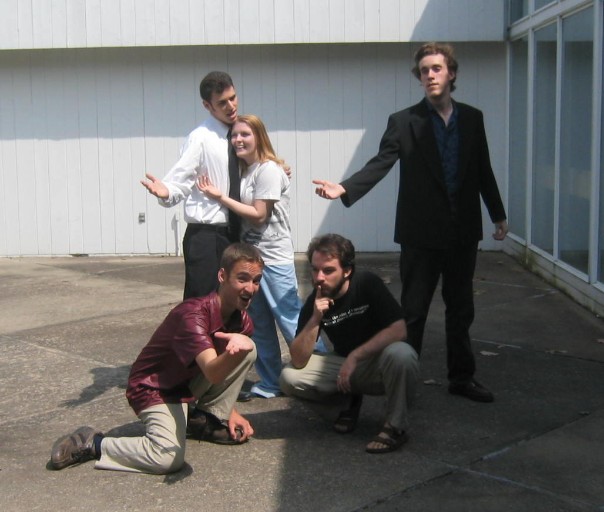
Richard Foreman performance: featuring actors myself, Russ, Abby and Nate, with our director Shawn looking pensive.

Richard Foreman performance: featuring actors myself, Russ, Abby and Nate, with our director Shawn looking pensive.

Standard
Theatre

Two Days of Two Handers

I finally returned to the theatergoing life this weekend by taking in a play on Saturday and another show on Sunday afternoon, both of which were “two-handers”, only starring two actors, just talking with each other, for an hour and a half or so. Clearly time well spent!

williamston-theatre-jpg-1

Saturday afternoon took me to the somewhat far afield but well regarded Willamston Theatre for their production of Frankie and Johnny in the Clair de Lune, a play that seems to be well known in the theatre canon but I had never seen performed. It was also made into a 1991 film that I recall seeing in video stores for some years afterward, though also have never seen.

This production took on a realistic look at two co-workers (I want to say “lost souls” but that seems a little too harsh) getting to know each other more intimately on a Saturday night in the New York City of 1987. We see them move through the motions of a first date, starting at the peak and going back down… and up again… and through their differing stages and perspectives of intimacy and acceptance.

As the couple, John Lepard and Suzi Regan are clearly acting pros, showcasing an easy, yet caustic rapport with each other and mostly believable roller coaster of emotions in reaction to one another. They were helped by an extremely detailed set, squeezed in to a narrow thrust/theatre-in-the-round type space, with a working refrigerator, stove top, sink and adjacent bathroom all helping to add realism to the story. Not to forget the wide range of costumes visible in a closet and artfully strewn about the floor.

While the script has dated slightly, giving the impression of a grimier and more violent NYC than exists today, along with some now-anachronisms like calling a radio station to ask for the title of a song, I felt that didn’t distract from the impact of the performance. I also felt like the actors effectively conveyed a sense of not overly dramatic, but urgent desperation in each other’s role — they want to connect with the other partner, but they might not know just how to do that.

This afternoon I walked steps from my front door to catch Performance Network‘s closing performance of Venus in Fur, a play that holds the honor of being the most-produced title at US theaters this season.

While this version didn’t feel quite as lively as it could be at times, in my opinion, it clearly showed the spark of David Ives’ writing and why the play has become so popular. Stressed out writer Thomas Novachek has completed a round of unsuccessful auditions for the new play that he’s also directing, based on a 19th century novel. As he’s getting ready to leave, in walks Vanda, who holds the same name as the play’s protagonist and quickly establishes a game of verbal cat and mouse with Thomas as she reveals more than she initially lets on.

The constant shift in balance of power – and characters not being what they seem – reminded me of a 2011 film, Certified Copy, which I promptly checked out from the Ann Arbor library and hope to revisit this week.

Actors Sebastian Gerstner and Maggie Meyer showed a deft command of the piece as they navigated the twists and turns of the plot. Meyer, in particular, seemed to be having fun with the demands of her role, requiring her to vamp it up to Noo Yawk levels at times, while building up the English/European character at other moments… and parade around in a sexy costume at the same time. I felt that Daniel C. Walker’s lighting design was another star of the show, emphasizing shadows at many instances, which added complexity to the pauses and banter of the two characters.

But I did feel like the production could have been livelier or snappier at times. I can’t put my finger on exactly what needed to be quickened, and it could be a reaction to seeing David Ives name as the writer, where he is best known for snappy comedies. I wouldn’t count this as a major fault, though, and it was clear that the simplicity of the piece – just two actors, etc – and relative modernity (a simple tale becomes more than it seems) have contributed greatly to the show’s appeal across the world.

Venus

Photo from main Performance Network VENUS IN FUR page, copyright Sean Carter photography


Standard
Theatre

Impressions and Recollections of an Artistic Leader

I recently learned that a past theatre collaborator, Vincent Dowling, died 11 months ago in Boston. I was sorry to hear this news, though Dowling was 83 and apparently in declining health. I was also sorry to learn it belatedly; the discovery was prompted by googling his name to see what he might be up to after learning that one of his granddaughters is currently appearing onstage at a prominent San Francisco theatre.

It was very inspiring to be able to work with Vincent at an early juncture in my career, when I was getting accustomed to a freelance-based work lifestyle I would enjoy more or less full-time for the next four years. He always had a glint in his eye and could clearly have lots of stories to tell, though I was both awestruck and respectful about his extensive theatre accomplishments and history, so I didn’t ask “so, what’s Tom Hanks like?” or “what’s it like to work at the Abbey Theatre?“… but I certainly thought it at times. An Irish op-ed sums up his legacy well – and adds an intriguing, and unsurprisingly slightly shocking, post-script.

The production at hand for us in Chester in 2007 was actually a double bill – “Dear Liar” and “The Gravity of Honey” – and will likely continue to stand as one of my most intense ever theatrical production experiences. We had six weeks to put up the two shows, and they almost completely shared a production team (I served as ASM) with Vincent directing one show and acting in the other, his daughter Bairbre appearing in both shows, and acting opposite David Birney appearing in the other show. By the time tech week rolled around, I was really feeling the intensity of the project, which had progressed from a modest start rehearsing in an old town hall to actually being in the performance space (in another town hall) and going right from one show to the next, while really living and breathing the theatrical environment in my staying in accommodation a short walk away… but I look back on it and know that I wouldn’t have had it any other way. (Something about that theatrical intensity!)

Regardless of the intensity, Vincent brought a graceful and spirited touch to the whole rehearsal and production process, nearly always offering a smile and twinkle in his eye along with a dedicated commitment to the craft. He seemed to inspire much loyalty in his collaborators (nearly everyone involved with the shows had worked with him before) and a recognition of the artistic commitment involved in putting on a play. I recall that I even felt inspired to come to rehearsals and performances in almost (but not quite) suit and tie garb … unheard of for a stage manager, but I felt that the project deserved that level of respect and commitment.

The opening night party at Vincent's home, with Vincent himself second from left.

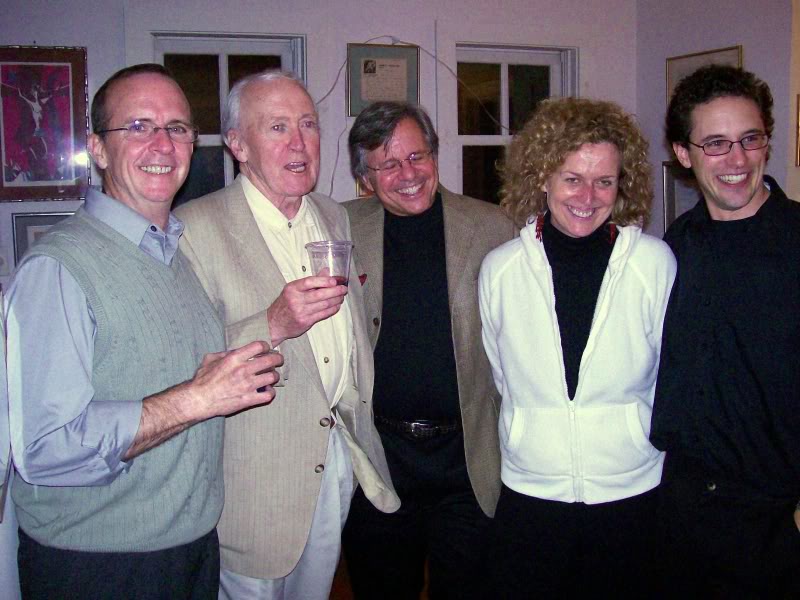
The opening night party at Vincent’s home, with Vincent himself second from left.

Standard