Movies

Bookending March at the Maple Theatre

IMG_1171I was pleased to realize upon March’s conclusion that (in the US at least!) I only visited independent cinemas this month, and in an unintentional coincidence, trips to The Maple Theatre (pictured at right) north of Detroit bookended my spring break adventures abroad.

I did deliberately choose to catch The Second Best Exotic Marigold Hotel prior to spring break, where it stars a number of well-known elder British actors. And the sequel is more or less an excuse to let them act again in a beautiful location. It’s most notable for the central performances of Maggie Smith and Judi Dench, given more dramatic space than in some of their other film portrayals, and Smith especially reminds the viewer of how much she can do with actual acting beyond just raising an eyebrow or giving a witty remark.

Last night I changed my earlier view and went back to the Maple to catch their last showing of Still Alice, the movie that gave Julianne Moore a well-deserved Academy Award and is now making its way out of theatres. As expected, the film is a showcase for Moore’s bravura and sensitive performance depicting a woman who faces a diagnosis of early onset Alzheimer’s disease. Something that may have gone less noticed in the awards season conversation is the effective supporting cast that surrounds Moore, most notably Alec Baldwin as her husband and Kristen Stewart as her youngest daughter.

While the film inevitably feels like a “movie of the week” at a few moments and has a slightly overcomplicated plot (does Stewart’s character really need to live in California if she can conveniently make it home for most of the film’s major scenes?), Moore’s sympathetic and nuanced portrayal overshadows those deficiencies to create a poignant and powerfully thoughtful cinematic experience.

*** for both films

Standard
Movies

London Cinema becomes a Sneak Preview Opportunity

My time in London is now in the rearview mirror and I hope to be back there again soon. Or at least sooner than 7 years from now!

As befitting a world class cultural center, my visit allowed for taking in of two films not yet released in the USA.

The first, Ex Machina, was an excellent and positive example of mismarketing. I recall the film’s trailer promising an explosive and somewhat action packed adventure and suggesting that the movie would be a familiar “rise of the machines” type action drama.

But the real film turned out to be a surprisingly intimate and provocative drama, with a few traces of action, that asks timely questions about the nature of intelligence and humanity. While the debate between man and machine is also covered along the lines of Blade Runner or some other of its cinematic cousins, this film also adds a gendered element where the machine is considered a female, while (her) observers and makers are male. In its use of an artificial or foreign female protagonist, the film recalls last year’s Under the Skin and could be seen as a continuation of that same story.

Domnhall Gleeson stars as a young prodigy seemingly randomly picked to spend a week at the secluded lab of Nathan (Oscar Isaac) who is a senior ranking member of his unnamed software and computer development company. The film drops us right in to the arrival and meeting of the minds, and wastes little time on unnecessary exposition. What follows stays in the realm of eerie plausibility as Gleeson meets Isaac’s latest artificial intelligence creation, the mysterious and inquisitive Ava, played by Alicia Vikander. Ava presents as female, leading to an eventual attraction between the two characters.

Although Isaac’s role could easily descend into a Dr. Frankenstein – ish extreme, his subtle portrayal, with several modern touches, ensures that the audience continues to think of him as an equal and not maniacal player in the equation between the central trio. Sonoya Mizuno also joins the fray in a minimalistic supporting turn, with one great out of left field moment.

The film eventually forces itself into a dramatic denouement along the lines of what one might suspect as the story goes on. But it never loses its initial air of intrigue and thoughtful (and somewhat plausible) integrity.

My Rating: ***1/2

The second film, I Am Michael, has attracted modest attention in the US press, from what I have seen, and seems to be awaiting an official release date as it slowly makes the festival rounds. It features a trio of well – known actors in the leading roles, with James Franco tackling the central role – and real person – Michael Glatze, a former gay activist who dramatically renounced his homosexuality and instead turned to a life as a Christian pastor in Wyoming, complete with bible school education. Zachary Quinto costars as Glatze’s long-term partner, with Emma Roberts appearing late in the film as a woman who becomes Glatze’s heterosexual partner.

I was not familiar with Glatze’s story, which was described in a New York Times article a few years back that served as the basis for this film. At some point I learned that Glatze had spent time at a Buddhist meditation center in Colorado where I have also spent time, and I might have met him, so that curiosity drew me in to see the film.

Franco appears to renounce his recent run of comedic (self-parodying) performances, which likely reached its peak or nadir with the Christmas spectacle The Interview, in this role. Instead of a smirking and self-satisfied attempt to channel a person, I again saw a real acting performance, with close attention paid to conveying Glatze’s internal struggle of how to define himself in the world.

Though Roberts and Qunito’s screen time is limited, both actors maintain the drama of the story arc. I haven’t seen much of Roberts’ work in other films, but did feel that she was particularly successful here in playing a more adult-oriented character, also presumably based on a real person.

The Buddhist connection that made me curious about the film is given limited exploration, and features primarily in a section of the film that feels like it rushes through what happens next in Glatze’s life after he breaks from his gay lifestyle. Veteran actress Daryl Hannah, who seems to have disappeared from films in recent years, appears briefly as the mediation center’s director.

The integrity and commitment of the performers felt somewhat let down by a poorly thought out script, which drew several (presumably) unintentional laughs from the audience in response to multiple instances of cliched dialogue. It seems inevitable that biopics also devolve into a run of greatest hits of the particular person’s lives.

Nonetheless, I hope this film finds an audience when it does reach the USA, if only for a closer look at several hardworking actors and a dramatic look at sexual identity, which remains a topic that is rarely seen in mainstream cinema.

My Rating: ***

Standard
Movies

The Many Faces of Julianne Moore

Julianne Moore at Cannes 2014 - image courtesy of Wikipedia.

Julianne Moore at Cannes 2014 – image courtesy of Wikipedia.

This (last) year’s Best Actress winner, Julianne Moore, is a long-admired film actress. Moore has achieved a rare feat of working steadily since she came to greater public attention in the mid 1990’s (and regularly before that time as well), along with continuing to move easily between smaller and studio cinematic projects.

In 2014, Moore initially gained received renewed attention for a darkly comedic turn in Maps to the Stars, which I saw at my local Cinema Detroit last week, before her acclaimed dramatic role in Still Alice took the awards circuit by storm starting with its premiere at the 2014 Toronto Film Festival.

I had originally intended for this post to be a compare and contrast between Moore’s work in those two films, but I came to feel that Still Alice, while undoubtedly a noble and important project in my mind, has reached a point of the storyline becoming too well-known so that the viewing experience for me would be more about “so when is ____ going to happen” or “is ________ actor going to show up again soon?” as opposed to being led along by the dramatic twists and narrative of the story. So I opted not to venture out to see the film.

It’s unfortunate, but that does happen with films that become well-known, and on a general principle I prefer to go in “cold” to a viewing experience, as it often leads to a more satisfying engagement with the material and artistry.

So, back to Maps to the Stars.

An ensemble cast of moderately recognizable faces navigates a familiar (in the age of TMZ and constant supermarket tabloid-ism) tale of morality and extremism under the setting sun of the Hollywood Hills. We meet Agatha (Mia Wasikowska), a new arrival to town, as she chats up a limo driver (Robert Pattinson) taking her around town. It becomes apparent that Agatha has some connection with an affluent family in town led by John Cusack, as a self-help guru, and Olivia Williams as his tense wife. Meanwhile, fading actress Havana Segrand (Moore) plots her comeback in the comforts of her large house, but she’s tormented by continued visions of her deceased mother, who was also a film star. A fun cameo from the inimitable Carrie Fisher, playing herself, helps to set the multiple storylines on a path to merging together.

To get back to the theme of this article, I found it interesting, but jarring, to see Moore and Wasikowska share several scenes together in a very different dynamic from when they starred as mother and daughter in the 2010 comedy-drama The Kids Are All Right. It’s a testament to the versatility of both actresses that they were able to pull off the different roles… but as an audience member I kept thinking back to that much warmer hearted and thoughtful film. I also sort of wanted Annette Bening and Josh Hutcherson to appear from a corner and pull them back into that other cinematic universe!

As befitting a film by David Cronenberg, the plot dabbles in a large amount of weirdness and surrealism. I think I enjoyed it more for uses of style than the actual narrative, which was less pleasing, particularly in a longer than it needed to be thread about a foul mouthed child star. I can see how Moore’s performance initially attracted attention, where she knowingly plays off the stereotype of someone really wanting to be in the spotlight… and does so without any hint of vanity, but… I’m sure she’s happier that Still Alice took over her dramatic momentum and accolades for 2014.

Film Rating: **

Standard
Movies

Live Long and Prosper

This month has been unintentionally quiet on the blog front, likely a combination of my self-imposed hiatus from social media and increased workload in the second semester of Grad School 2.0.

However, upon hearing today’s sad news of actor Leonard Nimoy’s death, I remembered that some of my most inspired recent writing here has been about Star Trek. And I realized that I’m paying tribute to Nimoy this afternoon and early evening by (once again) spending some time at Detroit Metro Airport, located in none other than Romulus, Michigan.

I was honored to share a hometown with Mr. Nimoy, and one time, my dad and I even got to see him live. In the fall of 1995 Nimoy underwent a book tour for his recently released second memoir, I Am Spock, and one of the stops was the Somerville Theatre. Oddly, this remains the only time I’ve ever been inside that locally acclaimed venue, although I’ve been outside it many times since that fall night.

Nimoy introduced a special screening of the two Trek films he directed – The Search for Spock and The Voyage Home – and gave an “intermission” talk about his new book. There was a raffle of just a few autographed pictures he’d signed that night, and to our surprise, we won one of them! The picture occupied a prominent home location for a number of years, and I still have it, somewhere…

Inevitably I feel a little bit of “I should have seen Nimoy live again at that Star Trek convention, that special screening, that art opening” – especially since he had a well rounded career with lots of diversity beneath the surface. But I’m grateful to have that one special memory and to have witnessed his gradual embracing in his later years of being a strong role model for the younger generation, as seen in many tributes today.

Standard
Movies

Mike Leigh continues to master the cinematic world: Mr. Turner

A planned theatre excursion yesterday became more modest with a trip back up to The Maple Theater to see Mr. Turner, the new film from acclaimed British director Mike Leigh that is enjoying an exclusive Detroit area engagement at that cinema.

Leigh’s masterful touch for storytelling, depth and composition is evident in every frame of this artfully assembled film. It was one of the most engaging biopics I have ever seen, in that the viewer is invited to walk along with the story as it progresses, and not given a specific sense of time via obtrusive title cards, fade outs, or montages. The level of detail in the film is quite frankly amazing, going from one setting to the next and not losing any focus, or drawing back with a wider landscape or vista from time to time.

Veteran character actor Timothy Spall appears in nearly every scene as the curmudgeonly Turner, and lends forceful presence to minor lines, especially a recurring quasi-grunt that becomes his signature statement as the film goes on. Spall reportedly spent two years learning how to paint in preparation for this role, which seems characteristic of the depth and intensity Leigh commands from performers who join him for his productions. Many actors, including Spall, recur over multiple Leigh films; others seen here include Ruth Sheen, who had a leading role in Leigh’s last film Another Year, and Lesley Manville, who also featured prominently in the previous film and I’ve had the pleasure of seeing perform several times onstage.

A series of short and evocative orchestral pieces by composer Gary Yershon also contribute to the rich texture of the film, and a subtle sense of time and life going on. (To reiterate) the exquisite level of detail really captivated me throughout the long film and seemed to fuse history, entertainment and cultural studies into a powerful and potent mix.

My Rating: ****

Standard
Movies

The Great Canadian Digital Film Festival

StandeeI was reminded of why I make a point of regularly checking the listings at the Cineplex Odeon Devonshire Mall when some old favorite films randomly appeared up on their schedule this past week. It turned out the cinema was taking part in a one week only “Great Digital Film Festival” – spotlighting classic films centered on fantasy, science fiction and adventure all across Canada. It seems this event has become a tradition for Cineplex filmgoers in recent years, and the impressively quirky lineup shows that they are programming for film lovers and not just to make some money off ticket sales.

For me, the choice of Blade Runner and Dick Tracy stood out the most, and conveniently, they were both showing on the same day. This was an audacious trek over the border, given that it happened to be last Sunday, the day the metro Detroit area received one of its largest snowfalls in a 24 hour period ever. But I forged ahead. When I did reach the Devonshire Mall, the cinema was not surprisingly sparsely populated.

Blade Runner AdBlade Runner was up first, and I’d actually previously seen the film on the big screen at the Palm Theatre back in 2008. But (no offense to the charming and unique Palm) the Devonshire Mall has a much more substantial film viewing experience, so I knew this time would be a fuller sensory experience. And that was just the case, with a crystal – clear print, Vangelis’ unique soundtrack oozing over the speakers, and the moody cinematography gaining more depth in its onscreen presentation where it should be.

It was a sort of “oh, aha!” moment to remember that the film takes place in 2019, which, of course, isn’t that far away at this point in time. I’d forgotten that a few of the lines of dialogue concerning Rutger Hauer, Daryl Hannah and co.’s replicant characters reference 2016 and 2017, just around the corner. Cineplex realized this coincidence as well and humorously played on it with their in-house advertising, as seen at right.

A long-awaited sequel to the film is reportedly close to shooting, but I have to wonder if they’ll delay the release until 2019 itself? It’s great to see the original film continuing to hold up so well and become even more prescient about our increasingly digital – obsessed world.

Dick Tracy was the evening show, and this was a major cinematic update for me, as I clearly recall seeing that film during its original run almost 25 years ago at the Star Theatre in St. Johnsbury, VT, even though I was just shy of my sixth birthday at the time – maybe it was one of the first “event movies” I ever saw?

Looking at the film now was, needless to say, a different experience. There was Warren Beatty in the lead, entering the autumn years of his career and playing a role that could/should have been played by someone younger – I believe Beatty was in his early or mid 50’s at the time of filming. There was Madonna, coming off her stratospheric debut decade and beginning the first of many image transformations over her long career. There was Al Pacino, overacting as usual and made up to be heftier onscreen. There was a boat load of other character actors, perhaps having more fun than the main cast in various levels of makeup and elaborate guises.

I’m certain I didn’t notice the technical mastery of the film when I looked at it through younger eyes. Today’s comic book movies really ought to have looked more closely at Beatty and co.’s depiction of a fabled world, using a very specific color scheme and deliberate lighting and editing choices, leading to Academy Awards for best makeup and art direction. As well, acclaimed composer Stephen Sondheim lent his distinctive composition talents to the movie’s original songs, and that led to an Academy Award for the main theme, “Sooner or Later“.

I don’t think I would enjoy Dick Tracy if I saw it for the first time today – the cartoonish violence overwhelms the main story, and is surprising given the PG rating, the characterizations are way over the top, Beatty is perhaps too old for the main role, and so on. But it sure was a big event movie in the summer of 1990 – I remember acquiring several collectable cards and likely a few other “must have” items related to the movie – so I’ll always recall its impact on that particular summer, like the best type of time capsule.

Thanks are due to Cineplex Odeon for programming these classics. I’ll look forward to seeing what they have up their sleeves next year.

Standard
Movies

Academy Award Also-Rans

A Most Violent Year finally arrived in wide release yesterday, following its initial Oscar-qualifying release in select cities on December 31st. So I caught the late show at AMC’s John R 15, in a screening room that had been surprisingly renovated into having recliner seats, rather than standard seating.

The film is the third feature written and directed by rising star JC Chandor, whose previous releases, All Is Lost (which I described here) and Margin Call (one of my favorite films of 2011), received wide acclaim. This time Chandor paired with actors Oscar Isaac, Jessica Chastain, David Oyelowo and Albert Brooks, along with a wide range of supporting characters, to deliver a complex period piece about a violent time in New York City’s history and one family empire’s role in a competitive business.

While all the performances were uniformly strong, I felt that Isaac didn’t offer particularly new shadings from previous roles. Interestingly, the film may or may not have deliberately made several winks to his role in Drive, where he played a character called Standard, involved with a shady organization led by Albert Brooks. And here he led the Standard Oil Company, which may or may not have come from questionable roots, and Albert Brooks appears as his principle advisor. Meanwhile, Chastain offered a slow burning performance that masterfully builds from demure to aggressive, with a key turning point happening when she and Isaac are out for an evening drive that suddenly turns a bit more violent. However, her character seemed to disappear from the last third of the narrative, perhaps as a reflection of Isaac’s independence from her interference.

The film delights in its ambiguity, although that made for a problematic viewing experience at times, as in trying to figure what was exactly driving the character motivations. The production worked hard to recreate NYC’s look of over 30 years ago, and a recurring theme of snow on the ground is an apt metaphor for the light and darkness of the story.

My Rating: ***1/2


Foxcatcher finally reached the Detroit area sometime just after the new year. I’d had a chance to see this film at Thanksgiving and again at Christmas in the Delaware area, not far from where the real life events took place, but held off until last week back at the Main Art Theatre.

Steve Carrell and Mark Ruffalo have received acclaim and Academy Award nominations for their work in this film, but Channing Tatum has been curiously overlooked and offers an arguably more impressive performance as he turns his easygoing screen persona inside out and works hard to portray a conflicted series of life events for real-life former wrestler Mark Schultz.

It was hard to shake the cold, alienating feel of this film, although it was also certainly well-made and very carefully put together by filmmaker Bennett Miller and his team. It was not hard to understand why the actors have been quoted as saying it was a difficult set to work on and they didn’t want to do much of anything after the day’s shooting.

I’ll close by saying that Miller’s nomination for Best Director seems particularly well-deserved here, and it would be a very different film if he hadn’t guided the story into a unique dark and thoughtful place.

My Rating: ***

Standard
Movies, Theatre

Sometimes the time is right for a trashy film, and that time is usually January

Last night, a planned excursion to see Brighton Beach Memoirs for the first time ever instead became a trip downtown to the RenCen4 cinema to catch new release The Boy Next Door. Because it was that kind of Friday night, where I had a late realization of needing to blow off steam and do something more mindless instead of being verbally and intellectually stimulated.

As I walked into the Renaissance Center, I suddenly realized that I was also paying homage to Boy Next Door star Jennifer Lopez’s best film role (IMO), Out of Sight, which I discussed in a blog entry a year or so ago and features a key sequence (visible on YouTube and slightly NSFW) set right at the top of the RenCen itself. As I said in that prior entry, I felt that Lopez showed more potential in that film than in any of her pre-music film roles and would be interested to see a parallel universe representation of a world where she only focused on film acting.

But this is 2015, and Lopez is, of course, a multi-hyphenate entertainer and now “celebrating 20 years in the business” (more than that, really) according to at least one promotional article I saw about this movie. I do wonder what today’s teenagers must think of her, and if they even consider that she’s had a movie career. In contrast, I first saw her on film when I was 11 in one of my first R-rated movie in-the-theatre viewings.

Lopez also served as a producer on The Boy Next Door, and spoke in the press of feeling resonance with the script. But I wondered how much she saw in it actually made it into the finished film.

The story immediately zeroes in on Lopez portraying Claire, a separated mother of one teenage son, Kevin, and a literature teacher at her son’s high school. Claire is navigating the feelings of being in her 40’s and wondering what comes next. Her husband, played by John Corbett, comes around occasionally to see their son, but the mood is uneasy (and hastily explained!) between the spouses after a recent cheating scandal by the husband. It’s the perfect situation for nice new neighbor Noah (Ryan Guzman) to make an entrance and assume the role of kindly neighbor, mentor to Kevin, and initial lust object for Claire. The film’s trailer (and nearly all of its marketing) is highly transparent about where things go from there, and so I’ll leave my synopsis at that, except to add that stage star Kristin Chenoweth makes a rare screen appearance in a supporting role as Lopez’s BFF and senior administrator at their high school.

Lopez brings a mostly bland presence to the central role, although she certainly still looks good, and seems to be having fun with a few moments in the story. The plot detail of her being a classics teacher allows the script to inject a few bits of thoughtful and winking intelligence, particularly around The Illiad. Chenoweth adds some sweet and tart character-filled spice to her scenes before getting pulled into a predictable closing arc. Guzman possesses the swagger of his character from the first scene onward, but adds little acting nuance. Veteran Corbett isn’t allowed to make much of an impression.

It seems clear that the film has a future as a camp classic, and that’s exactly the lens that I chose to view it through. There wasn’t really any other option, since plot twists fly in and out like the wind, characters disappear and reappear at random, and there were several examples of very abrupt jump-cutting from one scene to the next. One case in point: the film decides that it wants to have the three men in Claire’s life all hang out together. But they just get one short scene to do that. Director Rob Cohen, a veteran in the Hollywood industry, shows that he hasn’t lost his action movie skills in several random but well-staged car chase sequences. I particularly enjoyed the initial setup for the film’s finale, in which one character thinks they are tailing the other, but that is not the case, and Cohen reveals the truth with a taut panning shot worthy of a Hitchcock movie or more nuanced mystery. The film shows its modest budget at times in the staging of scenes with few extras and not using a huge variety of locations.

If not for Cohen’s steady grip on the lens, this film would likely be even more forgettable. It’s good to see Lopez back on the big screen and tackling an age-appropriate type of role. I can’t view the film strongly due to its cluttered narrative and cheesy plot. But ultimately it fits right in to that DVD discount bin of films that are kind of fun (if you don’t want to admit it and/or think too hard) and perfect for a particular moment when you want to sit back, relax and enjoy a new project from a familiar star.

MY RATING: **

Standard
Movies

Sneak Preview and Canadian Filmgoing Recap

I wrote this post back in December but only just re-discovered it on my hard drive. This film still awaits a US release!

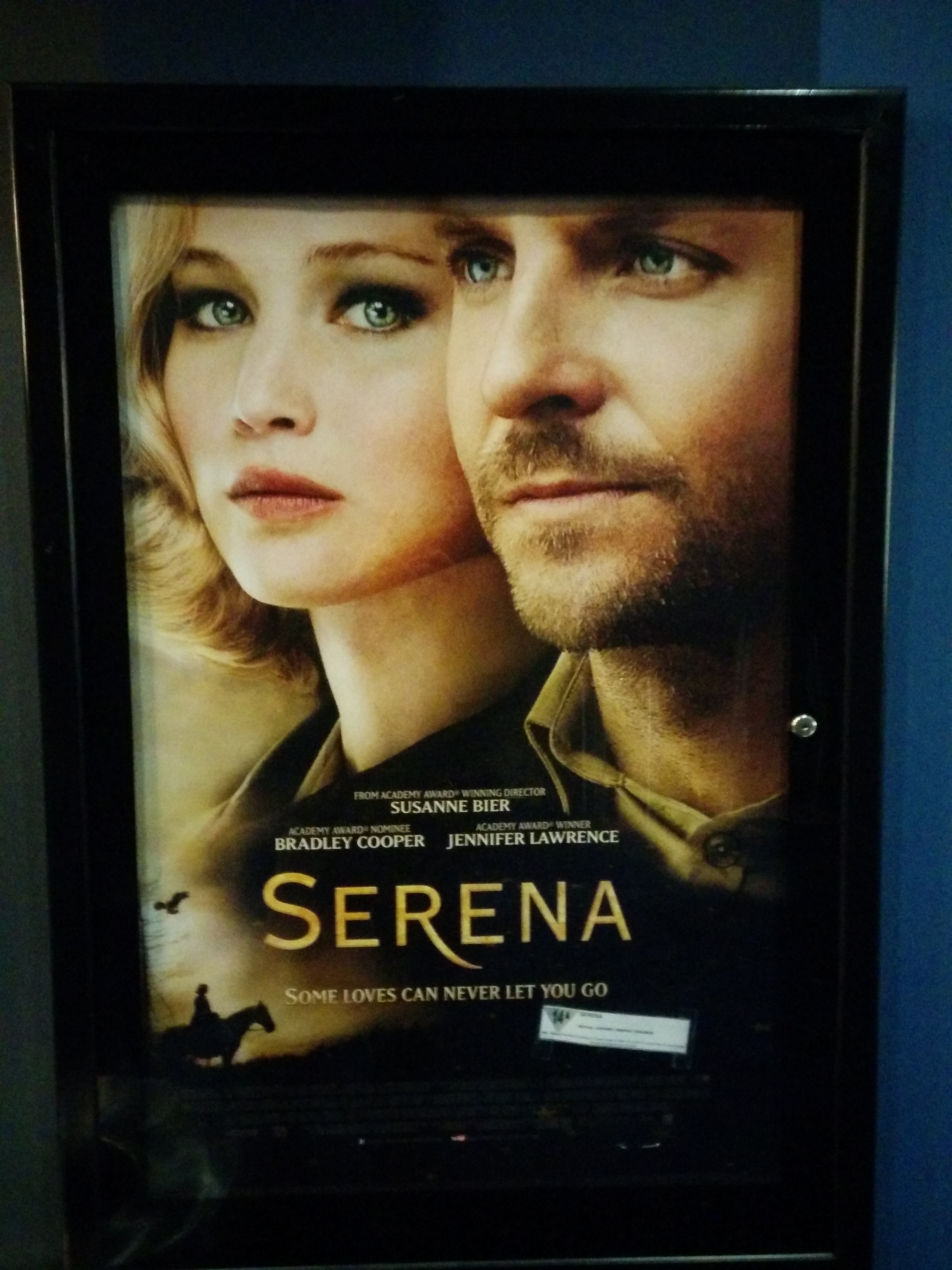
Silver City CinemaSERENA, which I caught over the border at the Silver City Cinemas in Windsor, a place that seems very far away at this writing, has yet to be released in the US, and has been plagued by financier problems since it was shot early in 2012. The director, Suzanne Bier, is rumored to have been uncertain about the tone she was going for and how to tell the story. And some of that uncertainty exists in the final cut that I saw, which lurches awkwardly from sweeping epic to intimate drama and doesn’t seem to have a through-line of dramatic tension or objective. Curiously, Cooper comes across well in the piece, although he should have done something about his mussy modern hair. He projects a solid double-edge to his character, who is meant to be a somewhat conniving townsman. I’m sure that another, perhaps older, actor would have added more depth, however.

Serena PosterAs for Lawrence, she’s really got to stop going into roles that are written for characters older than her early 20s real life age. This time, her character, the titular role, is meant to be the fulcrum from which everyone else revolves. She has flashes of intensity and ulterior motives, but it is inconsistent. Where Lawrence also became so well-known so quickly after hitting it big in 2012 or so, she may be running the risk of typecasting in that the audience expects her to act jovial. When she sticks to drama, as is the case here, it feels less genuine. The collective consciousness may have forgotten that her earlier roles – Winter’s Bone, The Beaver and others – were in fact highly dramatic.

Standard
Movies, Theatre

Appropriate Behavior and Familiar Faces

For the second year in a row, I had an experience of watching someone I knew “way back when” act in her feature film debut that is attracting significant industry attention and critical praise. This year it is Desiree Akhavan, last year it was Lupita Nyong’o. Both connections stemmed from my undergraduate years at Hampshire College.

Improv ClassAkhavan and I were two of ten students enrolled in a highly memorable (IMO) semester long study of improvisation (pictured at right) at Smith, which maintains its official status as a women’s college but welcomes students from the other four colleges in the region (Amherst, Hampshire, Mount Holyoke and the University of Massachusetts at Amherst) to take courses that might augment their studies at their home school.

In this particular class, taught by now professor-emeritus John Hellweg, the setting and the content were equally rewarding and challenging. We met once a week in the college’s boathouse, which doubles as a classroom, and went well beyond the familiar scope of improvising (comedy) into exercises that had considerably more meaning and depth. Elements of mysticism, storytelling, masks and inventive chose your own adventure were all part of the journey. We also expanded the role of the classroom, frequently leaving the boathouse for site-specific exercises such as seen in the photo above, near the college’s campus center. The class inspired me to incorporate elements of improvisation into my directing and character – building work, and I haven’t forgotten about that process today, even though my theatre work tends to be more in the front office than the rehearsal room.

It doesn’t feel easy to put into words what the experience is like to watch someone you knew earlier in their life on a big screen, though I am sure others have had similar feelings. Somewhere between awe, surprise, amusement, pride, acclaim, a little envy, some memory, and ultimately an appreciation. Those feelings all came to my mind as I enjoyed Appropriate Behavior, Akhavan’s feature film debut in a writer/director/lead actor trifecta. The film continues to play at Cinema Detroit this week and I’m pleased that my neighborhood cinema is one of a handful of theatres nationally showing the film.

Akhavan stars as Shirin, a 20-something Brooklyn resident struggling with personal identity issues after breaking up with Maxine (Rebecca Henderson), an at times forceful partner whom she “met cute” at a New Year’s party at some point in the recent past. Shirin aspires for a career in the film business, but after taking on a promising lead from a friend of a friend, she finds herself serving as a teacher to an afterschool program of very young (five year old) aspiring filmmakers. The events, along with her ongoing debate on if and whether to come out to her immediate family, add to a continuing sense of questioning for Shirin. But, with an assertive and bold temperament, she doesn’t sit around and mope, and part of the fun of the narrative becomes going along with Shirin to see what she does next, and how Akhavan’s own fresh writing deftly navigates gender, cultural and social stereotypes and expectations while putting a new spin on them against a contemporary New York City backdrop.

The film’s low-budget backdrop is apparent in some technical aspects of the story, such as lighting and sound, but doesn’t detract from the narrative. I might have appreciated some more clarity in the time shifting aspects of the narrative, but am not sure how that would’ve been best conveyed. As it stood in the finished film, it was sometimes difficult to tell where the action was in the linear timeline, and so it became like a mental jigsaw puzzle to put the different scenes together. Not a problem for me, just could have been smoother. Akhavan showed a committed hand in the direction of the film, eliciting assured and sharp performances from the whole ensemble along with herself. She demonstrates no hesitation in showing herself/the character in a potentially unflattering light, and ultimately, that added to Shirin’s endearing appeal and relatability, and is surely connected to why multiple press outlets have picked up on the film and her current contributions to pop culture.

And so how could I be anything other than impressed to see someone I knew way back when receive acclaim, interest and curiosity for her long-form debut? Here’s hoping that Akhavan has more stories up her sleeves and continues writing and producing in her assured, distinctive voice.

Standard