Movies, Theatre

European Film Expeditions

This week I have caught up on some recently released and filmed in Europe films, making me stoked to go back to The Continent during spring break next March.

Two FacesFirst up was the new thriller The Two Faces of January, adapted from Patricia Highsmith and from the writer of Drive. Hossein Amini retained his costar in the earlier film, Oscar Isaac, and added Viggo Mortensen and Kirsten Dunst into the mix as a central trio caught up in a deceitful web within 1962 Greece. All three actors find several elements to highlight of their roles, with Mortensen nailing the disheveled intrigue of a shady businessman, longtime cinema veteran Dunst offering a mature portrayal of a young woman caught between several worlds, and Isaac continuing to come up the ladder, cinematically, filling in the role of a man who has his hands in several parts of Athens life.

The actors are aided by carefully chosen photography and film work, emphasizing the colorful contrasts of Greece, and a reminder of an era when locations felt more far away (presumably) than they do in the present day, with real effort needed to get a specific plane ticket, to make your next travel connection, or make sure you still have everything you need for your out of the country identification and security.

The film might suffer from what I assume is a flimsy source material. Highsmith’s interest in shady characters, same-gender relationships and European locales is all there, but at a 90 minute running time, there isn’t much depth aside from the inciting event and what happens after that experience. A more seasoned director might have gotten deeper performances from the leads, though Amini’s experience with narrative tension comes in well late in the film with a series of “will they or won’t they succeed in _______ activity” sequences.

The second film of the week, My Old Lady, is a cinematic interpretation of a play originally seen at my “other” hometown theatre, Gloucester Stage Company, in 1996 and 2005. (I remember hearing of both productions but did not see either of them performed.) The film also marks the belated cinema directorial debut of Israel Horovitz, former artistic director of GSC and well – known in the theatre world. Throughout the film, its stage origins are clear, with some positive and some negative results.

my old ladyThe film also seems to be an excuse for its central trio – Kevin Kline, Maggie Smith and Kristin Scott Thomas – to flex their acting muscles in a new project. Scott Thomas has been seen onscreen before with both Kline and Smith, but not in the same film. IMDB says her role was originally scheduled to be played by Jane Birkin, which might have made more sense in the story.

As it is, the start of the film introduces Matthias (Kline), a down on his luck New Yorker who has recently traveled to Paris to inspect an apartment his recently deceased father has left him. He quickly learns that the apartment has been inhabited for many years by Mathilde (Smith), a woman now in her 90’s, and her daughter (Scott Thomas), neither of whom is receptive to his intention to sell the house for income purposes. The focus alternates between the three central characters as Matthias debates whether or not he wants to go through with the sale, while through a series of circumstances, Mathilde reveals that she knows more than she lets on about her family history and how the two younger people are connected to her and each other.

The script’s stage origins are clearly visible throughout the film, with several long monologues still in place and a few scenes clearly added to “open up” the plot and take advantage of the perennially picturesque Parisian locations. Most of the story settles in the central location of the Marais apartment, which seems to be quite large and endless, complete with an attached garden.

Kline seems to be enjoying the demands of the part, showing awkward alcohol – induced stodginess in several scenes, but then following it up with hints of long emotional neglect. Smith also goes beyond her current Downton Abbey stereotype of twinkling eyes and cutting comments, not hesitating to be forceful in several scenes while also showing genuine heart. Scott Thomas falls somewhere in between with a difficult part that seems to be in the middle of the two-character seesaw solely for reaction – based purposes. I can’t say that the film fully convinced me as a drama, but if its taken as an acting class from veterans and perhaps isolated out with just a few of the character monologues and moments, then the best parts come to light.

It was cool to see the full Art Deco experience of the Main Art Theater in action last night.

Main Art

Standard
Movies

Gone Girl hits a Home Run

I was very impressed with the new release Gone Girl, which I caught today at Royal Oak’s Emagine complex alongside a nearly sold out crowd.

It is difficult to construct a review around films that rely on plot surprises, and this one includes multiple twists and turns. So I will try to single out a few notable elements from the movie as a whole.

Ben Affleck shows he’s fully back in business from his comeback with a commanding, persuasive performance. The actor doesn’t shy from testing the viewer’s allegiances at multiple junctures in the story, and carries the film on his shoulders with a new maturity and complexity. He benefits from multiple scene partners and story angles throughout the movie, not only with lead co-star Rosamund Pike but also actresses Carrie Coon and Kim Dickens, who I was not familiar with.

Rosamund Pike has seemingly flown under the US radar for quite awhile; I remember seeing her featured in the James Bond film Die Another Day way back in 2002. Here she gets to show everything her acting skills are made of, in a multifaceted role that requires sex appeal, stature, cunning and dexterity in multiple ways. Pike passes the test and also shifts the viewer’s allegiances throughout the story, creating an intense and highly memorable 360 degree character portrait.

The entire supporting cast seemed to be carefully chosen to bring something unique to the screen and how the story is told. The aforementioned Carrie Coon and Kim Dickens do excellent work, with Coon and Affleck getting multiple scenes to play an intriguing sibling dynamic. Popular filmmaker Tyler Perry appears in a serious role, and seems to be having fun with the experience, bringing a sharp mix of focus and brevity to his scenes. Neil Patrick Harris makes a rare screen appearance and also gets to flex his dramatic muscles.

Director David Fincher continues his mastery of film with this release. He also offers small nods to several of his previous projects (IMO) or a clear evidence of evolving cinematic vision. Fincher again invited Trent Reznor and Atticus Ross to compose the film’s score, but this time, I felt that the two composers were not as on the ball as their Academy Award winning work in The Social Network. Their score is distractingly under tracked for multiple two person scenes which might have played more effectively without accompaniment. It still bears their unique industrial sound, and there are segments that stand out.

I detected a possible satirical element to some segments of the film, and found it unusual that as the story went along, it became a commentary on 2014 media obsessions. Not sure if that was a directorial or writer intention.

Author Gillian Flynn adapted her own novel here, and where she purposefully constructed the film version in a different way than how the story unfolds in the novel, it makes me intrigued to read it. Her dialogue moves the film along at a brisk pace, though Fincher might bring a more kinetic orientation than another filmmaker. However, Flynn shows her expertise in stacking and switching the narrative, which (I speak from experience) requires careful planning and sharp focus.

Standard
Movies

Her, Him or Them? (The Disappearance of Eleanor Rigby)

The film criticism will likely continue to keep a slower pace over the next few months, but I’ll still be doing it.

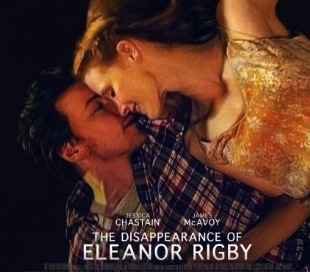
The Birmingham 8, formerly my distant arthouse/indie film destination, is now a local destination of choice. And so I made another visit there yesterday to catch The Disappearance of Eleanor Rigby: Them, the first installment of a trilogy of films telling the same story.

Having known about the “bigger picture” of the other films, I question the necessity of this one, subtitled Them, after seeing it. The story gets a detailed outline in this two hour version, but there are multiple instances where it feels like something is missing, or it’s an awkward switch from one perspective to another. I can’t completely tell if the decision to truncate the longer versions was solely a commercial decision, though I’m glad to know that the full version will still be coming to theaters in October, and hope that it will appear locally – perhaps again at the Birmingham 8.

eleanor rigbyJessica Chastain and James McAvoy give passionate performances as the central couple, subtly shading their characterizations as the story jumps around in time, showing both their initial attraction and later distancing after an (unseen) traumatic event. As the title character, Chastain particularly impresses with her initial free-spiritedness changing to a trauma-induced restraint and (seeming) coldness, until she (as the character) begins to let the changes settle in and re-focus her life. McAvoy does the opposite challenge, both in reacting to Chastain’s changes and conveying his own redirected journey.

The central pair is supported by a handful of supporting characters, and the film feels like it could be an intimate stage play at times with that narrow yet compelling focus. And I suspect that the full version (subtitled Him and Her) may feel like a reverse-persepctive novel brought to film.

Viola Davis, who previously appeared onscreen with Chastain in The Help, stands out in the supporting cast. (Why is Davis not top lining a film???) She delivers several initial tart lines with relish, and easily conveys a seasoned (yet weary) point of view as a college professor interacting with Eleanor and trying to get her back on her feet. Isabelle Huppert appears in a rare English – speaking role as Eleanor’s French mother, who seemed to always have a glass of wine in her hand. Oddly, the full view of the character is only expressed in scenes when she is not with Eleanor, but I suspect that is a writing trick to show what family members do and don’t say to their other relatives. Similarly, William Hurt conveys restraint as Eleanor’s father, but isn’t given a chance to show his full feelings until the very end of the film.

Additional supporting roles are filled by Jess Weixler, Ciaran Hinds, Nina Arlanda and Bill Hader. I’m sure that the full film gives more shadings to each of those roles, although Weixler and Hader do get a few notable scenes in the abbreviated take, and Hader also shows a surprising ease with the drama, given his status as a better – known comedy actor.

It is unfortunate that economics seemingly dictated the release of this abbreviated version of the story, but I’m relieved to know that the full film will still appear, where it received an apparently appreciative festival response and would certainly stand out as a novel take on how to tell a cinematic story.

Standard
Movies

Boyhood – a tribute to and exploration of life

I was very pleased to catch Boyhood on its opening day (Friday) at the Michigan Theater in an “exclusive Ann Arbor area engagement.” It’s amazing and impressive that a film like this stayed under the radar for so long (at least to the general public) until its release was confirmed sometime late last year or earlier this year.

The genesis behind the movie is now well – known, and so I won’t recap it here. I will add that the storyline achieves its goal of serving as a narrative time capsule of the past 10 – 12 years. Somehow director Richard Linklater had the foresight to offer lingering shots on various cultural objects – whether a Game Boy, older model car, Harry Potter release party, a bulky cordless landline phone, hit song from a particular year, etc – that the audience can recognize and relate to, or in some cases laugh at and be like “wow, I can’t believe I used that, or that thing was so common back then.”

From the very first shot of the movie, we are right there with the development and growth of Mason, played by Ellar Coltrane. The film tracks the journey of, but never feels like a spectator in, Mason and his family’s growth over the next 12 years. We meet his older sister Samantha (Lorelei Linklater), his mother (Patricia Arquette) and his distant father (Ethan Hawke). The parents are divorced with the mother taking primary custody, and her career and life path initially dictates the geographical range of the film as they move across Texas, the kids’ father comes in and out of their life, As Mason matures, he moves into the more direct focus of the narrative, and the last third or so of the film focuses on his own development in claiming an artistic life and stepping off on his own – into interpersonal relationships, career development, and a new life in college.

This was easily the most humane movie I’ve seen since Toy Story 3, with its tear-jerker of an ending, back in 2010. And this film touches the heart in a similar and different way, showing that life is relatable in its small, poignant, important moments, and drawing emotional truth, recognition and reflection from those same narrative themes.

On an industry – watcher note, it’s fascinating to see known actors Arquette and Hawke age on-screen; we can chart their growth in individual films over the years, of course, but never before in the same movie. Meanwhile, Coltrane and the younger Linklater mature into thoughtful young people, with a reflective poignancy present in their earlier in life scenes. Several actors move in and out of the narrative, and I wondered what that must have been like to come back to a project after a gap, or leave it after a year or two of working on it.

The film offers a fuller view of Texas than is usually seen on screen. Linklater directs with a steady hand, never letting a particular moment or theme overwhelm the narrative, or the story to be taken over by sentimentality or something that isn’t rooted in realism.

Best film of my year so far. I’m sure it will be hard to top. I almost don’t want to see another film this year after seeing this one.

boyhood cast

The cast and director as seen at the recent New York premiere.

Standard
Movies

A most missed man

most wanted manEarlier this week I returned to the State Theatre to catch current release A Most Wanted Man, which is notable, in an unfortunate and unforeseen (of course) way, for offering the last starring role of Philip Seymour Hoffman. The stars promoted the film at Sundance earlier this year, just a few short weeks before Hoffman’s sad and widely – covered in the media death. The film proceeded with its release, though it’s unclear to me how large of a rollout it will get.

The movie is not the action packed drama teased in the trailer, but instead takes a more thoughtful and process – oriented approach to its storyline. Eventually the events proceed in a manner similar to, but not quite as stylistically pleasing as, the adaption of Tinker Tailor Soldier Spy, written by the same author. This film lacks a compelling narrative structure that has made some of the author’s other works, most notably The Constant Gardener, more memorable in their cinematic adaptations.

Nonetheless, the story remains timely and topical. Hoffman takes the central role as Günther Bachmann, head of a Hamburg, Germany based spying agency. Bachmann and his associates, which include character actor Daniel Bruhl, are charged with monitoring a Chechen immigrant who has recently arrived in Germany via illegal means. The immigrant, Issa, has business he wants to attend to with a local banker (Willem Defoe) while his situation attracts the attention of a young lawyer played by Rachel McAdams. Meanwhile, Gunther deals with increasing tensions between himself and fellow CIA/Stasi-type operatives, including an American representative played by Robin Wright. While it’s great that Wright’s involvement with House of Cards has given her a reinvigorated career profile, her role here seems too similar to that show, and it feels like her distracting brunette bob was an afterthought attempt by the producers to further differentiate her character. The “and” credit before her name is a further giveaway that her role will not be central to the plot but will come in at a few key scenes.

As for the rest of the cast, the marquee names acquit themselves well. Dafoe offers a tonal opposite from his role in The Grand Budapest Hotel earlier this year, and where he’s someone I often think of as playing villainous or “heavy” type characters, this role’s emphasis on uncertainty and more emotional angles seemed to be a refreshing change of pace. McAdams doesn’t seem to have aged at all since her initial breakthrough roles 10 years ago (!) and presents a mostly-convincing German accent for her scenes. Her infectious smile and good humor, widely used in other films, are rarely seen here.

Hoffman performs his role in German – accented English and displays the same unrivaled intensity that made him so renowned and acclaimed in the business. His absence hangs over the film like a melancholic cloud from the beginning, although I found myself getting immersed in the story and forgetting, for a bit, about the outside circumstances around him. The evocative final shot of the film is a fitting finale for his cinematic presence. (He will return, however, in the upcoming Hunger Games continuing chapters.)

The film’s problem lies in its lack of a compelling storyline. And while Issa ultimately becomes the central character, the “most wanted man,” the character is seen almost completely in solemn, very serious scenes, and given little room to grow or develop empathy with the viewer, which may be a joint fault between the writer and the performer. The situation with Issa is established with urgency, and there is a strong opening sequence establishing the character’s arrival in Hamburg, the security presence in the city, and why the characters might be interested in following Issa. But things slow waaaay down after that, and it’s difficult to sustain interest in what the story holds for the characters. However, some twists and turns involving the lawyer, and who knows what in relation to whom, ultimately manage to keep things interesting.

The film is drenched in ominous colors of grey, black and steel. As I noted above, the characters rarely break a smile. There is an intriguing balance of power constantly shifting and changing gears in the story. But the film as a whole has to be one that you are in the mood for, with lots of gloom and seriousness and definitely not a choice for a light night out.

Standard
Uncategorized

Summer Solstice Arts Binge

I spontaneously yet purposefully structured this year’s Summer Solstice as an opportunity to focus on local culture and arts offerings. I felt that the harsh winter made Detroit – area culture rescind into the background for me more than I would have liked – though it was probably more a case of having to seek it out more directly – and so I am happy to see various cultural festivals and outdoor attractions now back in force. (Including my current project of working on The Penny Seats production of Elektra, due to open on July 10.)

First up was a drive to Detroit to check out this year’s edition of the River Days Festival. (I was in the city during last year’s festival, but did not attend for unknown reasons… I think that was the first time I went over to Windsor instead. Shows how times and priorities change!)

This festival is a great way for the city to turn its eye to the river, which seemed more blue and inviting than ever, and there was a similar festival apparently taking place on the other side in Windsor. Multiple ships were plowing the waters, some seeming to party more than others, and there was even a Tall Ship at dock, which had come down from a point in the Saginaw area. 

I don’t usually post travel-blog type photos here but I feel compelled to share a few highlights since it was such a scenic day:

ImageImageImageImageImage

As I enjoyed the sights, I couldn’t help recalling what the same vista had looked like just five months ago:

Image

But it’s the wrong time of year to focus on a view like that 😀

I might have stayed longer in the city, but had made a decision earlier in the day to stop by Tipping Point Theatre in Northville to finally catch a production at that company. Their current production, The Red King’s Dream, will be running for one more week in its US premiere.

Written by a Canadian playwright, this script reminded me very much of Goodnight Desdemona, Good Morning Juliet, which my friends and colleagues The Penny Seats produced in their inaugural season three years ago, and later seemed to enjoy a brief revival of interest, with productions popping up in San Francisco and New York City, and probably a few other places. As for this show, I’m not sure if it will enjoy continued productions, but Tipping Point seems to appreciate it.

It follows the story of Steven, a classic loner type who works diligently in his crowded apartment to created indexes for an overbearing boss. The boss figure, a domineering woman, often visits him and clearly exerts a strong control over his actions and activities. He’s also often visited by a close friend who lives nearby, and his mother calls him, but there seem to be no other people in his life. One day, an attractive woman, Zoe, moves into his building and they meet by chance. Steven begins to feel an attraction to Zoe, but because he’s so socially inexperienced, he isn’t sure if he wants to reveal that attraction or not. Naturally, everyone’s relationships with Steven come to a head in a climactic dinner party scene. The script also includes some not well thought out (IMO) references to Lewis Carroll and Alice in Wonderland (hence the title) although that element does give a chance for the actresses to sport some great costumes in bookend-type scenes.

Sooo… this show struck me as something I’d usually refer to as a “crowd pleaser,” meaning that it can appeal to a wide audience but won’t necessarily end up on a critic’s top 10 list. All four actors deliver committed performances, although Zoe (Maggie Mayer) isn’t really given a chance to speak for herself until the final scene. The script often ventured a bit too readily into slapstick or “oh I can’t believe he said that” moments, and the awkwardness of the Steven character could have been easily suggested rather than so obviously spelled out.

Image


On the other hand, the set design, as seen in the above image, could have been a character in itself, with a richly detailed checkerboard floor, hundreds of books carefully set in locations around the 3/4 thrust stage, and a hint of offstage activity as well.

Later in the day, back in Ann Arbor, I paid a visit to the unique Carriage House Theatre for the first time. This group shows an impressive commitment to challenging works. This summer they plan three productions, and their first one, Phedre, was enjoying a sold-out closing performance.

I tried not to compare the production too much to the filmed-theatre version I saw in 2009 with Helen Mirren in the lead role. This time the action was much more immediate, with just a small suggestion of a set and the actors doing their best to let the words speak louder than their actions. I don’t feel like I want to single out a particular moment in this production, but I was impressed with the actors capability and commitment. 

Attending the production gave me the stamina I was looking for to finally attend an installment of the State Theatre’s monthly midnight movie series. After noticing, wanting to attend, and ultimately not making it to screenings of films including 2001Fight Club and Wet Hot American Summer, this time the movie of the night was Serenity, which is now (gulp) nine years old but was met with much anticipation when it was released in late September 2005. Several friends from Hampshire College and I eagerly attended one of the first screenings at CInemark Hampshire Mall soon after it opened.

But despite that early anticipation, the movie’s box office returns disappointed, and no further sequels were made, though the film’s storyline leaves the possibility open.

And so in 2014 I was/am looking at the film in a historical context … would it be more successful if it was released today? (perhaps.) could Joss Whedon’s vastly increased celebrity and cache impact a future revival of this show? (probably.) did this show contribute to the now popular binge watching trend, where its predecessor Firefly TV series was under appreciated in initial airing but became hugely successful on DVD? (yes.) was the show and movie a launching pad for greater success for the actors involved? (mostly, from what I can tell.)

The State was at least 3/4 full for the screening, and the audience was more like a live audience at times, eagerly responding to twists and turns in the plot. Seeing the film again left me with an active looking-back feeling, where something I/you appreciated some time ago is right there in front of you, and so associated sensations and memories come back… but then it’s time to return to the present.


Standard
Movies, Theatre

Saturday Night Doubleheader

It felt like my old days of Bay Area arts-going as I enjoyed a live performance followed by a film in close proximity to each other (and walking distance from my apartment!) in downtown Ann Arbor this evening.

First up was an Ann Arbor Summer Festival kick-off appearance from Ms. Lily Tomlin – a Michigan native and (obviously) esteemed performer who does not act or present like the stereotypical/imagined 74 year old. Tomlin seemed to relish being onstage, frequently walking around with her hands outstretched like a very dedicated power walker, and easily slipping in, vocally and physically, to various characterizations from her catalogue. She also incorporated several video segments into her monologue, mixing a bit of older excerpts with some material that may have been conceived especially for this show. Perhaps most impressively, she delivered her whole 90 minute set as an extended monologue, barely pausing for breath on a handful of occasions and never needing to look at a card or any sort of prompt.

While I enjoyed the opportunity to see a legend like Ms. Tomlin onstage, I didn’t feel 100% connected to her material and felt that I might not be in the intended age range and/or demographic that she is gearing towards. I don’t hold that against her at all and am grateful for the chance to see her live, as she always has projected intelligence, fun and good humor in the various television and film projects I have seen her in over the years.

On my way back towards my apartment from Hill Auditorium, I noticed that my erstwhile favorite art house, The State, had some new films on the lineup, including Cold in July, which happened to be starting its late show right when I was in front of the cinema. So I ventured inside.

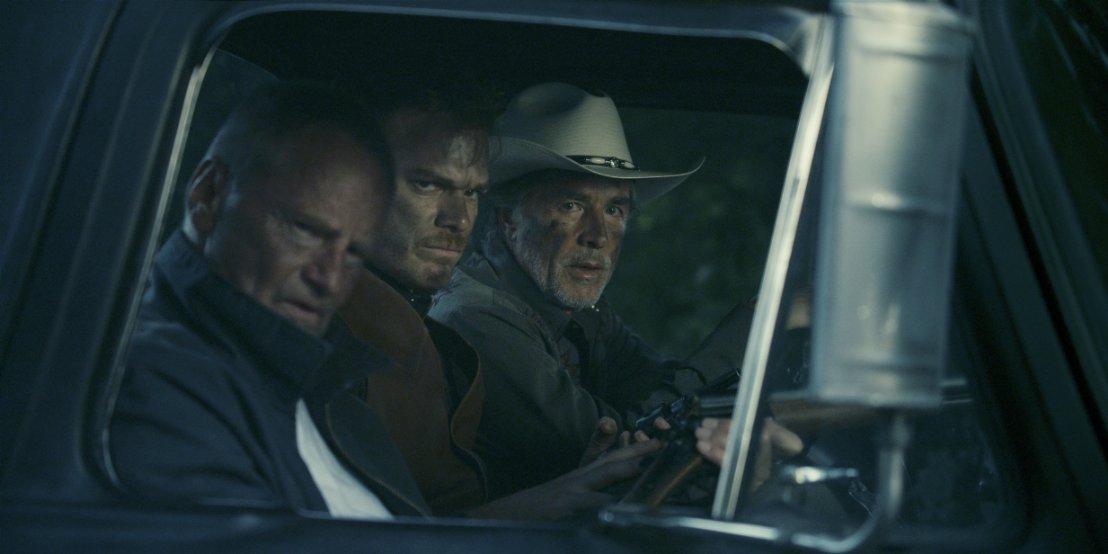
cold in julyThis film oozes Texas character, and at times seems like a sibling to No Country for Old Men as it tracks another trio of Lone Star State characters seeking vengeance for mysterious – and not clear until the final reel – acts. It is also based on a book, though I had not heard of the title.

Subtlety is the name of the game as the plot unspools, with Michael C. Hall in the central role projecting resoluteness alternating with uncertainty. He is strongly supported by older veterans Sam Shepard, who needs no introduction but really shines here after window-dressing in his August: Osage County cameo appearance, and an initially unrecognizable Don Johnson poking fun at his suave reputation, and then going deeper as the story goes on. Up and coming celebrity progeny Wyatt Russell makes an appearance late in the film as a key character, and isn’t given much to do or say, but projects strong screen presence. Character actress Vinessa Shaw gets the major female role, and while unfortunately she isn’t given much to do, she continues to demonstrate an intelligent screen presence that I first noticed way back in Hocus Pocus.

The familiar plot concerns the ricochet effects that happen to Hall and Shaw and their son after Hall suddenly shoots an intruder in their home late one night. The first quarter of the film covers standard police procedural territory, and then things turn more interesting after that, leading to a predictable, though well thought out explosive finish. The story doesn’t really tie up all of its initial loose ends, but it seems to be more concerned with the mood and impact of the violence. I guess that means more realism, and some of the scenes – and Hall’s remorse and uncertainty alternating with resolve – recall the recent Blue Ruin.

Technical elements of the film are solid if not outstanding, with the most detail seemingly on the 1989 period setting. Fitting in with the subtlety, and possibly low budget, I liked that most of the elements were suggested rather than fully realized, such as old cars tooting around the dusty Texas town, a night drive to the Houston area with only a distant highway sign giving a sense of place, and the finale initially beginning offscreen, but audible, and the main character moving into the forefront of the action. I could have done without, or preferred a different, music score from the at times heavy-handed cues that were used, emphasizing classical music and speaking for some of the character motivations in place of dialogue. I appreciated the act by act structure of the plot, in that it was well defined, and again feel that morality tales such as these are great fits for late shows on a Friday or Saturday night.

Standard
Movies

International Indies

As the summer movie season continued to rev up its engines this past weekend, I was pleased to go the other direction and take in two independent films, on opposite sides of the border.

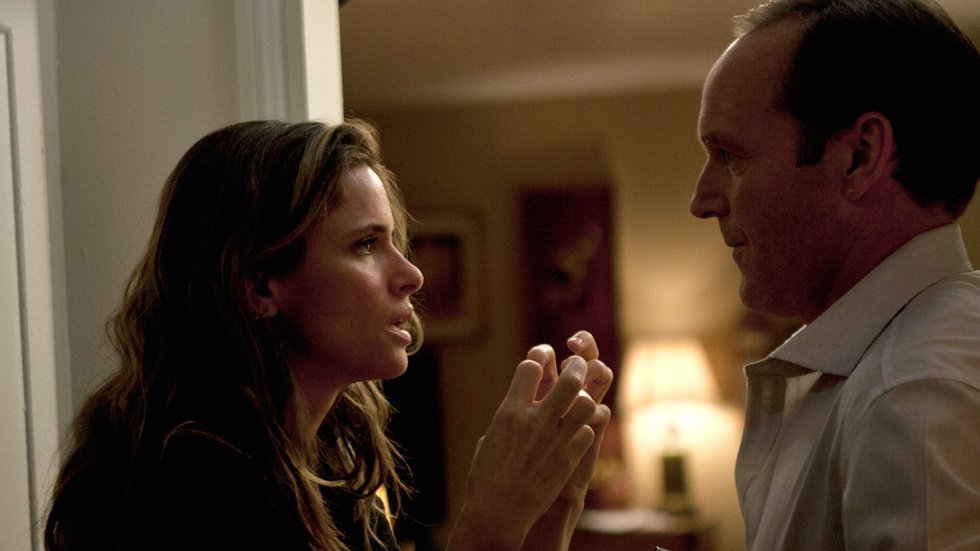
On Friday I happened to notice that Trust Me had appeared at the Quality 16. I had not heard much about this film, but a look at the cast list (written and directed by Clark Gregg, with featured roles for Amanda Peet, Allison Janney, Felicity Huffman, Sam Rockwell, and several other notable actors) showed that it might be a project of note.

Gregg wrote and directed the film, in addition to playing the lead role, and so I wondered how cathartic or personal the experience had been for him. Some scenes, most notably involving Huffman’s agent/casting supervisor character, had a strong industry bite to them, while others, mostly focused on Gregg’s own likable but awkward main character, went on for too long or did not seem well thought out.

The plot focused on Gregg’s character, a former child star turned acting coach for young actors, and his troubles fitting in to the fast – moving, changeable Hollywood system, as seen through his interactions with two primary younger clients. After meeting the second one (Saxon Sherbino) by chance, he quickly gets drawn into her and her father’s world as Hollywood outsiders, with him serving as the guide for the out-of-towners coming in from Oklahoma. Along the way, he is glad to get to know his neighbor (Peet) more intimately.

But in a sudden shift for the plot and for the film as a whole, Gregg discovers that the girl and father may not be what they seem, and spends the remainder of the movie (this is all crammed in to the last half – hour) trying to get to “the truth” and putting bis career on the line, which ultimately creates challenging and surprising results for everyone involved.

I feel like this movie had good intentions and rose above the label of “vanity project” thanks to plot and commitment of the esteemed actors. But what if the late in the film plot twist had not occurred and the story went in a different, yet still unpredictable direction? I wonder if that would have made things easier to digest or reinforced the allegorical parody style of the script. As it stood in finished form, the ending put a somewhat sour taste in my mouth, though I wasn’t completely down on the whole film.

peet and gregg

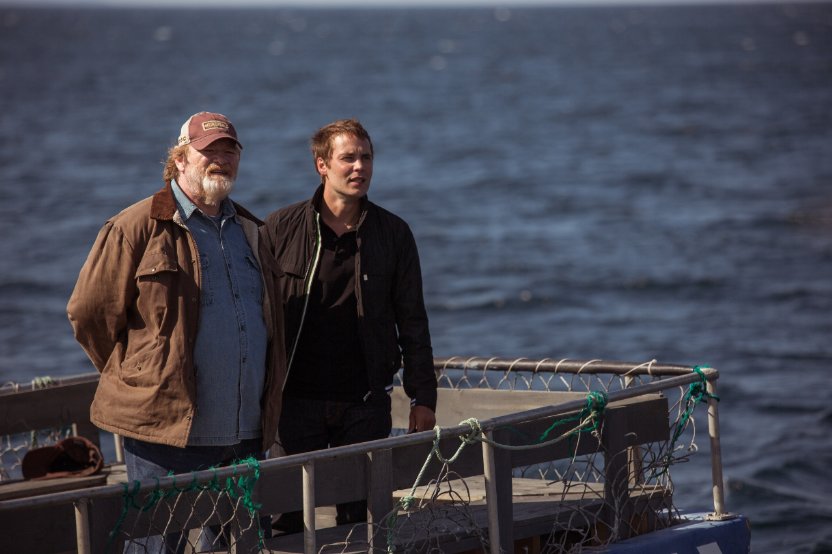
The next day, while on a visit back over to Windsor, Ontario, I noticed that the Devonshire Mall Cineplex Odeon was again offering a not-advertised-as-such Sneak Preview of a film not yet enjoying a wide US release. In this case, The Grand Seduction had been on my radar as a film spotlighting the majestic Canadian Maritime Provinces (it was filmed in Newfoundland) and offering a possibly rare starring role for character actor Brendan Gleeson, with Taylor Kitsch in a co-leading role, and a slew of Canadian actors in supporting roles, including Gordon Pinsent, who’d shown a more dramatic side in Away from Her several years ago. I didn’t realize that Pinsent is over 80 years old; he doesn’t seem it.

This film made laugh out loud and gaze with awe at the cinematic landscapes more than any other film I have seen in recent memory, but, the plot should have been simplified. Gleeson is the self-appointed mayor of a small Newfoundland coastal town falling on hard times based on lack of employment and job opportunities in general. Someone in the town, I forget who, decides that the town has an opportunity to serve as a site of a new oil and gas (or something like that) production factory. But first they have to prove they are ready to host the new factory, which is where Kitsch comes in as the young hotshot doctor that the town goes to extreme lengths to convince that he may want to stay there more than one month.

Sounds like a crowd pleaser, right? It was, but there was just TOO MUCH PLOT. Kitsch’s opening scene should have been cut, and his second scene, which does a better job of setting up his character, put in his place. Gleeson’s wife moves to the mainland for another job at the start of the film, which sets the plot in motion, but then (minor spoiler) she decides to return home at the end with what felt like the flick of a hand. Other townspeople are introduced, most notably a crafty and younger postmistress who may or may not have eyes for Kitsch, but the movie eventually becomes so overstuffed, it’s impossible to get a sense of their various character arcs. And towards the end of the film, Kitsch makes a not-quite-believable quick decision that contributes to the end of the story, but felt like a cop-out to me.

In spite of that, the movie is filmed completely on location, with the lush, green cliffs of coastal Atlantic Canada on full display, and the picturesque village coming across as a character of its own. The film’s music score makes use of charming, and regionally appropriate, fiddle music at multiple instances in the story.

So, if the viewer is game for going along with the ride, and feeling like they are part of a small coastal town where everyone knows your name, but doesn’t want to think too much about the plot (or just suspend their disbelief) this one is a great choice. Interestingly, it was originally a French – Quebec film; I can’t recall seeing an example of a Canadian company remaking a film from elsewhere in the country, although I am sure it has happened.


grand seduction

Standard
Movies

Lose Momentum, Gain Momentum

After a strong start to the month, it’s clear that blogging was not my primary focus as the month of May went on.

BUT THAT’S OKAY.

I continued my filmgoing throughout the month with the following titles, all linked to their IMDB pages.

Only Lovers Left Alive
On My Way
X-Men: Days of Futures Past
Belle
Locke

Of those films, I would say that On My Way, with enduring French screen icon Catherine Deneuve, was the most satisfying.  Makes me want to do a European vs. American cinema post in the near future…

deneuve

Standard
Movies, Theatre

Don’t shoot her

elaine372Versatile and legendary actress Elaine Stritch first came to my attention in a somewhat unmemorable role (for her – as I learned later) in the 1997 comedy Out to Sea, part of a series of films that comedy legends Jack Lemmon and Walter Matthau made together near the end of their careers, and sadly, lives. In a classic eye roll inducing example of Hollywood casting, Stritch portrayed Dyan Cannon’s mother, even though the actresses are only 12 years apart in real life. Stritch commanded the screen in her few scenes, most notably tearing up a rug with fellow veteran Donald O’Connor to a cheesy rendition of “Sea Cruise.”

At some point in the next couple of years I became aware that Stritch is, in fact, a legendary stage actress, arguably best known for originating a role in Company by Stephen Sondheim but boasting many other accomplishments. As a theatre professional I recall noticing that her most recent Broadway appearance, starring in A Little Night Music with Bernadette Peters, was perhaps more successful than the original revival marquee pairing of Catherine Zeta – Jones and Angela Lansbury.

In the present day, Stritch has slowed down, somewhat, and departed her longtime home base of New York City for a new/old home right here in the state of Michigan, where she was born and lived until her late teen years. It seems that old age (she’s now 89) and health have caught up with her, although, on the other hand, she also seems to be a textbook study in “never say never.”

And so the documentary film Elaine Stritch: Shoot Me is making the rounds at cinemas around the country. I first heard about this film well over a year ago and found the actual experience of seeing it to be somewhat anticlimactic for that reason. I also may have been feeling some residual annoyance that I did not attend its Michigan premiere over in Birmingham last month, for which Ms. Stritch was also in attendance.

The film takes an unflinching look at Stritch’s life circa 2011 – 2012, as she continues to perform mostly in cabaret settings, struggles with problems related to the aging process, begins to tire of life in Manhattan and (somehow) maintains a resiliency that “the show must go on” – to use a cliched but true phrase. Stritch demonstrates resiliency, commitment and salty enthusiasm in all of her projects, perhaps most notably in her balance of masking her difficulty in memory into a sort of comedic act with her musical director when they are performing… to the audience’s delight.

I found the scenes where Stritch was at her most genuine to be the most appealing. These moments took the form of when she was with family members or close friends. There she was as a veteran and accomplished performer earning her accolades but also going with the flow and not getting too worked up about something not going right, a deadline or an impending decision that had to be made. It seemed those moments, with her broad and genuine smile and satisfaction, showed her at her most honest.

Ms. Stritch has been vocal about a seemingly and understandably rough transition into her life in Birmingham, but based on recent interviews it appears that things have settled down for her a bit more now, and I do hope that she’ll make a few more appearances in the metro Detroit area, which seems very honored to count her as a regional native.


Standard