Movies

Third Person Drama

My series of weekend late shows at the State Theatre continued last night with the new release Third Person.

The film is begin sold as “from the writer/director of Crash” and shares many similarities with that 2005 opus, which I found interesting on first (and possibly only) viewing, but is definitely a film that has not aged well.

Liam Neeson takes the central role as an accomplished writer, Michel, who is working hard on his latest novel, but is also working through some changes in his personal life, having decamped to Paris for an extended rendezvous with a  younger flame (Olivia Wilde) and left his wife (Kim Basinger) behind in the USA. We are introduced to several secondary characters as parallel story lines quickly take shape.

In New York City, an estranged couple (Mila Kunis and James Franco) engage in a custody battle over their young son, with the support of a lawyer (Maria Bello) and several additional characters. Meanwhile, in Italy, an American businessman (Adrian Brody) meets a mysterious local woman (Moran Atlas) and is drawn into her current predicament that eventually takes them to several places across Italy.

The stories intercut with each other and with the continued development of Neeson and Wilde’s storyline, so that you know they will eventually be linked in some way, and that connection is revealed at the very end of the film.

Only problem was I guessed the connection about a third of the way into the film – and it becomes increasingly clear if you pay attention to various visual clues.

Haggis displays a similar heavy-handed approach here as seen in his earlier films, which I feel might have been initially appreciated but now are greeted with less enthusiasm. I felt that most of the actors struggled to commit to their roles, with Kunis being a particularly glaring example of trying to give A Serious Performance … and not convincing me. (In contrast, her subtle, intense dramatic role in Black Swan continues to stand out in my memory.) I felt that Brody showed the most commitment to the material, which is interesting as his storyline initially seems the most tangential, but becomes the most endearing of the three.

On a related note, WHERE HAS KIM BASINGER BEEN? Her appearance here is criminally brief, but serves as a sharp reminder of her talents. I felt that she and Neeson should have spun themselves off into a separate movie focused on an age-appropriate romance or adventure. On the opposite side, JAMES FRANCO CONTINUES TO BE EVERYWHERE and strained credibility in his role as an accomplished New York painter, with his usual smirk lurking below his serious expressions.

Neeson acquits himself well, but suffers from a contrived role. It’s refreshing to see him stepping back into adult dramas after (what feels like) several years of only focusing on action movie work. I hope that other audiences will be reminded of his earlier work – and potential for future roles – with this performance. I felt that Kunis and Wilde ought to have switched roles, where the actresses’ strengths might have been more visible in their opposite parts. As it is, Wilde enjoys several sharp – tongued script moments but suffers from an overabundance of gratuitous girlfriend scenes, with accompanying nudity.

Curiously, one of the film’s best scenes sees Wilde and Neeson visit a Parisian dance club, where they briefly interact with some locals and express their intimacy through dance and silence, accompanied by a new track from Moby. The scene shows an easy comfort with simplicity, and what’s said and isn’t said, that the rest of the movie, with its overwrought and heavy – handed exposition, sorely lacks.

The new song’s video doubles as an extended informercial for the film:
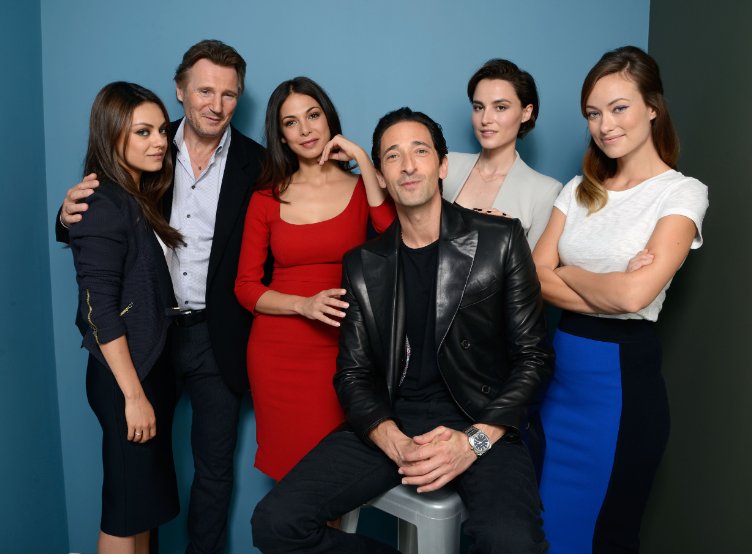
You'd be drawn to a film with a cast like that, right?! (photo from IMDB)

You’d be drawn to a film with a cast like that, right?! (photo from IMDB)

Standard
Movies

Midyear 2014: top 5 films

Inspired by my friend Gabe Valdez’s recent chronicles of top films for 2014 so far, I thought I would offer a brief summary of my own opinion.

JANUARY – JUNE 2014 – saw 21 films that were released in 2014, plus several holdovers from 2013 and a few revivals/special screenings of older films.

TOP FIVE FILMS

1. Chef
Everything is told in such a warm – hearted and also exuberant style, including an emphasis on colors in the frame, tantalizing shots of food onscreen, and the family relationships of the characters pushed to the front of the story, that this became one of the most appealing and satisfying films I have seen in some time.

2. Blue Ruin
The film offers a tense yet understated look at the “revenge thriller”, which one article about the film pointed out used to be much more common in Hollywood films (think late 90′s/early 00′s films often starring Ashley Judd) but is now less common. In this case, the minimalism is apparent right from the start when the first 20 minutes or so have nearly no dialogue, but are carried along by a crackerjack music score, character activity, and intriguing, immediate curiosity over the motivations and history of the main character.

3. Under the Skin
Scarlett Johansson adds to an impressive recent repertoire of roles with this performance, The actress strips away (quite literally at times) her aura of Sex Symbolness and Appeal, taking us back to an earlier era somewhere around ten years ago when she was more known just for her performances and less for her off-screen activities.” I’m looking forward to re-visiting this film when it comes to home media, as it is deserving of a second viewing and might be helped by knowing the plot, where the initial viewing in the theater was an unsettling, though memorable, experience.

4. In Secret
…An impressive lead performance from Elizabeth Olsen and nuanced support from Oscar Isaac (doing a quick turnaround from Llewyn Davis and seemingly enjoying a chance to show some dramatic range), Tom Felton (leaving Draco Malfoy behind with a sense of earnest joy) and Jessica Lange (chewing the scenery in style). The performances were really the showcase of the film… I also want to mention British character actress Shirley Henderson, who popped up as a neighbor knowing more than she lets on.

5. Enemy
Gyllenhaal masters a dual role, giving one of his finest screen performances in the last several years… Villeneuve masters elements of mood and style here, letting an omnipotent Bernard Hermann-esque music score racket up the tension in key moments, alongside cinematography of metro Toronto seen in hazes and sepia tones.”

Standard
Movies

Can’t/Must Stop the Train


Film poster courtesy IMDB

Film poster courtesy IMDB

Snowpiercer has arrived as curious anomaly or antidote to the summer movie season. Its cold, dark winter setting makes it seem more appropriate for a holiday season release, and a pointedly grim atmosphere clashes with the sunshine currently widely present outside movie theaters. But a relatively star-studded cast, with at least two Oscar winners and three Oscar nominees, plus two current popcorn-movie leading men, lends some credence to the summer release plan.

Set in the not-too-distant future, with references to an inciting event said to take place right here in 2014, the film tells the story of the last survivors on Earth who have been hauled together on an endless train ride, following a failed attempt to balance out the planet’s climate problems. The train is a microcosm of what’s left of humanity, but also shows the lingering tensions and anxieties of such relationships.

We’re introduced to the lower-class members of the train who are forbidden from moving forward thanks to on-train law enforcement. Occasionally they are addressed by Mason (Tilda Swinton) – a warden of sorts who tries to be somewhat humane to them at times, and maybe has a conflict between what she is doing and what actually happens to the lower-class individuals.

The first scene makes it clear that Curtis (Chris Evans – doing a total 180 from his “Captain America” life) is the ringleader of the rear-class citizens. He and a few friends including Edgar (Jamie Bell) are working to determine a way to get to the front of the train, aided by some assistance from Gilliam (John Hurt) – an older passenger who helped construct the train. A community of families is also evident in the group, with Tanya (Octavia Spencer) and Andrew (Ewan Bremmer) emerging as key representatives from that section of the population.

Because some of the players, Curtis included, have been trapped in the back of the train for so long, they have some misgivings about actually going ahead with their attempt to go to the front of the train. But several incidents and plot developments arrive in quick succession, and so Curtis takes the lead of going off into their unknown. The group quickly learns that they will not have an easy journey and that the train is more complex than any of them could have imagined.

I am impressed that a film like this, which could be summarized as “The Matrix on a train,” attracted such a star-studded cast. While a few performers (John Hurt, Ed Harris) offer variations on similar roles in their past or archetypal roles, others such as Evans and Swinton offer distinctive portrayals very different from previous performances in their filmography. Character distinctions are further highlighted by all of the rear-class citizens having some form of grime and muck on their body, while those closer to the front of the train have flawless skin. This is most sharply realized in a surprise cameo from Allison Pill as a teacher who seems to have a heart of gold, in spite of the circumstances (but does she?)

Director Joon-ho Bong makes his English-language debut with this release, and his Korean roots are evident in the choreography of fight scenes and use of actor Kang-ho Song in a key role. However, several of those same fight scenes take the violent elements longer than American audiences might be used to, and certain plot elements that might be suggested are actually visually explored, thus making the film hard to watch at times. The greater plot element of a class system on a contained environment is notable, and continues to find relevance in the present era.

I felt that same artistry contributed to the success of the film at other times, as in several moody sequences through the lesser-known (to the lower class citizens) areas of the train where ambient noise and active visuals take the place of dialogue, a sudden left-turn moment in a classroom car on the train, and a climactic sequence with a well-known actor appearing as the mastermind behind it all. The dark train ride is occasionally supplemented by beautiful cinematography of an endlessly snow-covered landscape, and the pace of the film does not feel rushed or locked into a blockbuster-style showdown at the end of the story.

I can’t recommend this film with gusto due to the high violent content and several derivative plot elements, but I feel that it will sustain itself as a notable release from this year. It’s great to see the cast members committing to their parts – though Swinton is always memorable in her roles. I particularly hope that the movie continues to stand out on Evans’ filmography, as he capably turns away from the “American Hero” role he’s become known for, and shows more depth and commitment to the part than possibly any other role he has done before.

Standard
Movies

An actress lightens up and the summer screens get tuneful

I often forget that British actress Keira Knighley is one year younger than me. She has more or less pigeon-holed herself into a dour screen persona that rarely expresses a happier state of mind, which also makes her seem older than her age. So when she does lighten up, as in the current release Begin Again, it’s a breath of fresh air.

I was pleased to catch an early screening of this film at Landmark’s Main Art Cinema in Royal Oak, which often gets first dibs on independent film releases in the Detroit area. Knightley gets top billing as Greta, a British ingenue who is making her way in New York City with her rapidly ascending rock star boyfriend, played by Adam Levine. One night, a series of circumstances leads her to a grungy club somewhere in the city, where her path intersects with Dan (Mark Ruffalo) – a down on his luck music executive who feels like her song could hit the big time.

The rest of the film follows their journey to get Greta’s record made, which takes several twists and turns as she does not want to sacrifice her own vision while Dan navigates a modest midlife crisis. They are joined by several memorable characters as the film unfolds, including James Corden as a friend of Greta’s, Mos Def as Dan’s business partner, Halle Steinfeld as Dan’s estranged daughter and Catherine Keener as Dan’s estranged wife.

The film is a cheery tale that is hard to be critical about… but I’ll try to make a few comments. It bears a number of similarities to the director’s previous film, Once, and could almost serve as a sequel to that project with Knightley taking the role of the female singer in the previous film. There are probably too many montages in the film, with most accompanied by songs from the soundtrack, as the story attempts to cover a large amount of narrative in a 90 – 100 minute time frame.

The storytelling does yield one interesting choice in the use of a “flash-forward/flash-back” structure to set up both Greta and Dan’s story lines. I always appreciate when films or plays choose that particular narrative, as it keeps the audience members guessing and anticipating, and sometimes creates some surprises along the way. As well, the film keeps the audience guessing if Greta and Dan will keep things platonic or get to know each other on a more intimate level.

In spite of the formulaic approach, the actors seem to be having fun with their process, with Ruffalo taking on a familiar character (in the context of his previous roles) but showing more humanity and older mentor-style energy than before. Keener only gets a few notable scenes, but continues to maintain her strong screen presence and mature character persona. Steinfeld leads the rest of the cast, and while more emphasis is placed on her character in the first half than the rest of the film, she continues to show strong command of her roles and great potential for future opportunities.

I’m sure this film will take its seat as the Summer Indie Crowd Pleaser of 2014.

Standard
Uncategorized

Summer Solstice Arts Binge

I spontaneously yet purposefully structured this year’s Summer Solstice as an opportunity to focus on local culture and arts offerings. I felt that the harsh winter made Detroit – area culture rescind into the background for me more than I would have liked – though it was probably more a case of having to seek it out more directly – and so I am happy to see various cultural festivals and outdoor attractions now back in force. (Including my current project of working on The Penny Seats production of Elektra, due to open on July 10.)

First up was a drive to Detroit to check out this year’s edition of the River Days Festival. (I was in the city during last year’s festival, but did not attend for unknown reasons… I think that was the first time I went over to Windsor instead. Shows how times and priorities change!)

This festival is a great way for the city to turn its eye to the river, which seemed more blue and inviting than ever, and there was a similar festival apparently taking place on the other side in Windsor. Multiple ships were plowing the waters, some seeming to party more than others, and there was even a Tall Ship at dock, which had come down from a point in the Saginaw area. 

I don’t usually post travel-blog type photos here but I feel compelled to share a few highlights since it was such a scenic day:

ImageImageImageImageImage

As I enjoyed the sights, I couldn’t help recalling what the same vista had looked like just five months ago:

Image

But it’s the wrong time of year to focus on a view like that 😀

I might have stayed longer in the city, but had made a decision earlier in the day to stop by Tipping Point Theatre in Northville to finally catch a production at that company. Their current production, The Red King’s Dream, will be running for one more week in its US premiere.

Written by a Canadian playwright, this script reminded me very much of Goodnight Desdemona, Good Morning Juliet, which my friends and colleagues The Penny Seats produced in their inaugural season three years ago, and later seemed to enjoy a brief revival of interest, with productions popping up in San Francisco and New York City, and probably a few other places. As for this show, I’m not sure if it will enjoy continued productions, but Tipping Point seems to appreciate it.

It follows the story of Steven, a classic loner type who works diligently in his crowded apartment to created indexes for an overbearing boss. The boss figure, a domineering woman, often visits him and clearly exerts a strong control over his actions and activities. He’s also often visited by a close friend who lives nearby, and his mother calls him, but there seem to be no other people in his life. One day, an attractive woman, Zoe, moves into his building and they meet by chance. Steven begins to feel an attraction to Zoe, but because he’s so socially inexperienced, he isn’t sure if he wants to reveal that attraction or not. Naturally, everyone’s relationships with Steven come to a head in a climactic dinner party scene. The script also includes some not well thought out (IMO) references to Lewis Carroll and Alice in Wonderland (hence the title) although that element does give a chance for the actresses to sport some great costumes in bookend-type scenes.

Sooo… this show struck me as something I’d usually refer to as a “crowd pleaser,” meaning that it can appeal to a wide audience but won’t necessarily end up on a critic’s top 10 list. All four actors deliver committed performances, although Zoe (Maggie Mayer) isn’t really given a chance to speak for herself until the final scene. The script often ventured a bit too readily into slapstick or “oh I can’t believe he said that” moments, and the awkwardness of the Steven character could have been easily suggested rather than so obviously spelled out.

Image


On the other hand, the set design, as seen in the above image, could have been a character in itself, with a richly detailed checkerboard floor, hundreds of books carefully set in locations around the 3/4 thrust stage, and a hint of offstage activity as well.

Later in the day, back in Ann Arbor, I paid a visit to the unique Carriage House Theatre for the first time. This group shows an impressive commitment to challenging works. This summer they plan three productions, and their first one, Phedre, was enjoying a sold-out closing performance.

I tried not to compare the production too much to the filmed-theatre version I saw in 2009 with Helen Mirren in the lead role. This time the action was much more immediate, with just a small suggestion of a set and the actors doing their best to let the words speak louder than their actions. I don’t feel like I want to single out a particular moment in this production, but I was impressed with the actors capability and commitment. 

Attending the production gave me the stamina I was looking for to finally attend an installment of the State Theatre’s monthly midnight movie series. After noticing, wanting to attend, and ultimately not making it to screenings of films including 2001Fight Club and Wet Hot American Summer, this time the movie of the night was Serenity, which is now (gulp) nine years old but was met with much anticipation when it was released in late September 2005. Several friends from Hampshire College and I eagerly attended one of the first screenings at CInemark Hampshire Mall soon after it opened.

But despite that early anticipation, the movie’s box office returns disappointed, and no further sequels were made, though the film’s storyline leaves the possibility open.

And so in 2014 I was/am looking at the film in a historical context … would it be more successful if it was released today? (perhaps.) could Joss Whedon’s vastly increased celebrity and cache impact a future revival of this show? (probably.) did this show contribute to the now popular binge watching trend, where its predecessor Firefly TV series was under appreciated in initial airing but became hugely successful on DVD? (yes.) was the show and movie a launching pad for greater success for the actors involved? (mostly, from what I can tell.)

The State was at least 3/4 full for the screening, and the audience was more like a live audience at times, eagerly responding to twists and turns in the plot. Seeing the film again left me with an active looking-back feeling, where something I/you appreciated some time ago is right there in front of you, and so associated sensations and memories come back… but then it’s time to return to the present.


Standard
Uncategorized

Cecile Encore

On Wednesday night I was very pleased to catch a performance by “up and coming” jazz vocalist Cecile McLorin Salvant for the second time, after previously being wowed by her late last summer at the Detroit Jazz Festival. She did not disappoint, and seemed to add more insight and character in this performance. In the previous show, she had been more of a “featured vocalist” while here she was the star attraction. With a velvet voice and graceful stage presence, she is amazingly only in her mid 20s.

I wish I knew my jazz catalogue better to be able to specifically cite the songs that she and her very tight three piece band performed. It seemed to veer between lesser-known compositions and more familiar works, with a few songs not usually portrayed as jazz thrown in, such as “Something’s Coming” from West Side Story. All four performers displayed a delicate balance of complimenting each other while finding moments for their individual contributions to shine.

It’s great to see that McLorin Salvant has an active presence on YouTube. I feel this excerpt, which must be from the 2012 Detroit Jazz Festival, is a particularly good example of her performance power and skills:

Standard
Movies, Theatre

Saturday Night Doubleheader

It felt like my old days of Bay Area arts-going as I enjoyed a live performance followed by a film in close proximity to each other (and walking distance from my apartment!) in downtown Ann Arbor this evening.

First up was an Ann Arbor Summer Festival kick-off appearance from Ms. Lily Tomlin – a Michigan native and (obviously) esteemed performer who does not act or present like the stereotypical/imagined 74 year old. Tomlin seemed to relish being onstage, frequently walking around with her hands outstretched like a very dedicated power walker, and easily slipping in, vocally and physically, to various characterizations from her catalogue. She also incorporated several video segments into her monologue, mixing a bit of older excerpts with some material that may have been conceived especially for this show. Perhaps most impressively, she delivered her whole 90 minute set as an extended monologue, barely pausing for breath on a handful of occasions and never needing to look at a card or any sort of prompt.

While I enjoyed the opportunity to see a legend like Ms. Tomlin onstage, I didn’t feel 100% connected to her material and felt that I might not be in the intended age range and/or demographic that she is gearing towards. I don’t hold that against her at all and am grateful for the chance to see her live, as she always has projected intelligence, fun and good humor in the various television and film projects I have seen her in over the years.

On my way back towards my apartment from Hill Auditorium, I noticed that my erstwhile favorite art house, The State, had some new films on the lineup, including Cold in July, which happened to be starting its late show right when I was in front of the cinema. So I ventured inside.

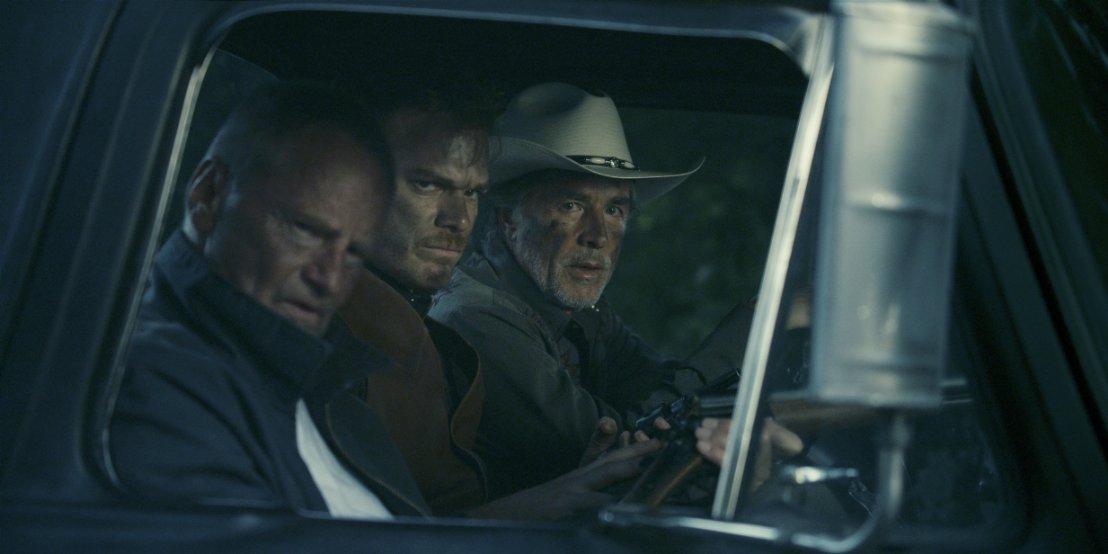
cold in julyThis film oozes Texas character, and at times seems like a sibling to No Country for Old Men as it tracks another trio of Lone Star State characters seeking vengeance for mysterious – and not clear until the final reel – acts. It is also based on a book, though I had not heard of the title.

Subtlety is the name of the game as the plot unspools, with Michael C. Hall in the central role projecting resoluteness alternating with uncertainty. He is strongly supported by older veterans Sam Shepard, who needs no introduction but really shines here after window-dressing in his August: Osage County cameo appearance, and an initially unrecognizable Don Johnson poking fun at his suave reputation, and then going deeper as the story goes on. Up and coming celebrity progeny Wyatt Russell makes an appearance late in the film as a key character, and isn’t given much to do or say, but projects strong screen presence. Character actress Vinessa Shaw gets the major female role, and while unfortunately she isn’t given much to do, she continues to demonstrate an intelligent screen presence that I first noticed way back in Hocus Pocus.

The familiar plot concerns the ricochet effects that happen to Hall and Shaw and their son after Hall suddenly shoots an intruder in their home late one night. The first quarter of the film covers standard police procedural territory, and then things turn more interesting after that, leading to a predictable, though well thought out explosive finish. The story doesn’t really tie up all of its initial loose ends, but it seems to be more concerned with the mood and impact of the violence. I guess that means more realism, and some of the scenes – and Hall’s remorse and uncertainty alternating with resolve – recall the recent Blue Ruin.

Technical elements of the film are solid if not outstanding, with the most detail seemingly on the 1989 period setting. Fitting in with the subtlety, and possibly low budget, I liked that most of the elements were suggested rather than fully realized, such as old cars tooting around the dusty Texas town, a night drive to the Houston area with only a distant highway sign giving a sense of place, and the finale initially beginning offscreen, but audible, and the main character moving into the forefront of the action. I could have done without, or preferred a different, music score from the at times heavy-handed cues that were used, emphasizing classical music and speaking for some of the character motivations in place of dialogue. I appreciated the act by act structure of the plot, in that it was well defined, and again feel that morality tales such as these are great fits for late shows on a Friday or Saturday night.

Standard
Movies

A tasty cinematic surprise

Chef PosterThe other day I decided that I needed a close-to-end-of-week cinematic break. So I went back over to the Quality 16, my neighborhood megaplex, thinking I’d bow to crowds and go to Edge of Tomorrow. But starting at a slightly more convenient time was Chef, a movie I hadn’t heard much about but seemed to snugly fit my preferences for independent cinema.

This was a great experience of “going in cold” (not knowing much about) to the movie. I see now that the film’s trailer gives away many of the good comedic moments and provides a broad outline of the plot, which is meant to be more surprising in the film’s narrative context. But since I had not seen the trailer – or didn’t remember it – that was not a problem for me.

The movie focuses on a turning point in the life of Carl Casper (writer – director Jon Favreau) who enjoys an OK life as head chef at a swanky, but wants to be better Los Angeles restaurant. A few sharp opening scenes clearly set up the story there, where Carl seems to want to return to a professional culinary life where he can do more of what he wants, but is stymied by a controlling boss (Dustin Hoffman in a well-played and well-placed cameo role.) Meanwhile, his assistants (John Leguizamo and Bobby Canavale) still support him, and the hostess (Scarlett Johansson) seems to have eyes for him.

And then in Carl’s non-work life, he is trying to be a good example to his son, who only sees him part-time and spends the rest of the time at his mother (Sofia Vergara)’s opulent estate-style house. Carl doesn’t seem to see that his son wants more out of the relationship, but the son cleverly gains the upper hand, as only smiling 10 year olds can do, at several instances in those early scenes.

Things come to a head for Carl when a popular regional food critic (Oliver Platt) decides that he will be reviewing the restaurant. Carl and boss and associates spar over the servings for the night in question, and there are multiple lingering effects for all involved for several days afterwards.

At this point, the film introduces its most modern and surprising element: a wholehearted acknowledgement of the social media age. Carl has not kept pace with the world of Facebook, Twitter, YouTube, instant journalism and celebrity news… but everyone else around him has. He quickly learns the pros and cons of the field, and for a while I thought the movie was turning into a satire on how obsessive and compulsive these digital worlds have become, like a national obsession. The movie seems keenly aware of this option as the plot thread continues to be integrated throughout the rest of the film.

But instead, after a small helping of satire, the movie makes a left turn, and gains a warm heart. Carl’s ex points him in the direction of Miami, where all three family characters have history, and he ends up in the office of an old friend (Robert Downey Jr. in another well-placed cameo) who offers Carl the chance to take over his old food truck. With a little help from his friends and some key, warm support from his son, Carl sets off on a journey of redemption and new opportunity back to Los Angeles.

The film doesn’t end with that meeting! The story continues as Carl and friends get the truck operational and have a southern tier cross-country experience through New Orleans, Austin and points in between on their journey back to California. And there are further opportunities that appear when life in Los Angeles resumes.

The story might sound predictable in this outline, but everything is told in such a warm – hearted and also exuberant style, including an emphasis on colors in the frame, tantalizing shots of food onscreen, and the family relationships of the characters pushed to the front of the story, that this became one of the most appealing and satisfying films I have seen in some time.

Some outlets are suggesting that this film is Favreau’s own redemption or return to the indie world after a series of ups and a few downs in big – budget Hollywood filmmaking, and I could see how there might be some truth to that. But he also seems to enjoy using his increased industry cache to draw in Hoffman and Downey Jr. for winking cameos, along with an uncharacteristically dowdy Johannson willing to play a supporting role, and a luminous Vergara making the viewer feel right at home and as if they know her character.

It is clearly a familiar plot, but it’s played so well, and with insightful nods to the modern era, that the film is a breath of fresh air to the early summer movie season.

Standard
Movies

International Indies

As the summer movie season continued to rev up its engines this past weekend, I was pleased to go the other direction and take in two independent films, on opposite sides of the border.

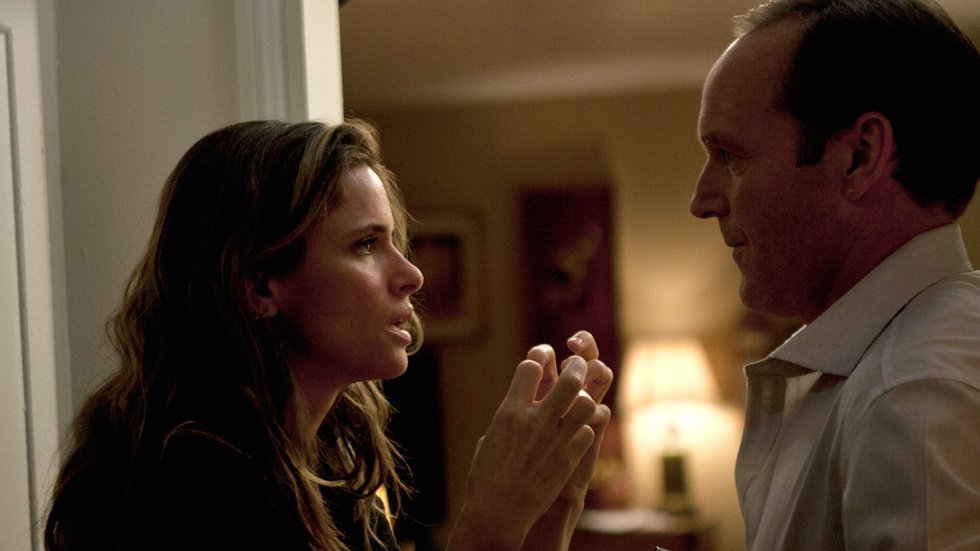
On Friday I happened to notice that Trust Me had appeared at the Quality 16. I had not heard much about this film, but a look at the cast list (written and directed by Clark Gregg, with featured roles for Amanda Peet, Allison Janney, Felicity Huffman, Sam Rockwell, and several other notable actors) showed that it might be a project of note.

Gregg wrote and directed the film, in addition to playing the lead role, and so I wondered how cathartic or personal the experience had been for him. Some scenes, most notably involving Huffman’s agent/casting supervisor character, had a strong industry bite to them, while others, mostly focused on Gregg’s own likable but awkward main character, went on for too long or did not seem well thought out.

The plot focused on Gregg’s character, a former child star turned acting coach for young actors, and his troubles fitting in to the fast – moving, changeable Hollywood system, as seen through his interactions with two primary younger clients. After meeting the second one (Saxon Sherbino) by chance, he quickly gets drawn into her and her father’s world as Hollywood outsiders, with him serving as the guide for the out-of-towners coming in from Oklahoma. Along the way, he is glad to get to know his neighbor (Peet) more intimately.

But in a sudden shift for the plot and for the film as a whole, Gregg discovers that the girl and father may not be what they seem, and spends the remainder of the movie (this is all crammed in to the last half – hour) trying to get to “the truth” and putting bis career on the line, which ultimately creates challenging and surprising results for everyone involved.

I feel like this movie had good intentions and rose above the label of “vanity project” thanks to plot and commitment of the esteemed actors. But what if the late in the film plot twist had not occurred and the story went in a different, yet still unpredictable direction? I wonder if that would have made things easier to digest or reinforced the allegorical parody style of the script. As it stood in finished form, the ending put a somewhat sour taste in my mouth, though I wasn’t completely down on the whole film.

peet and gregg

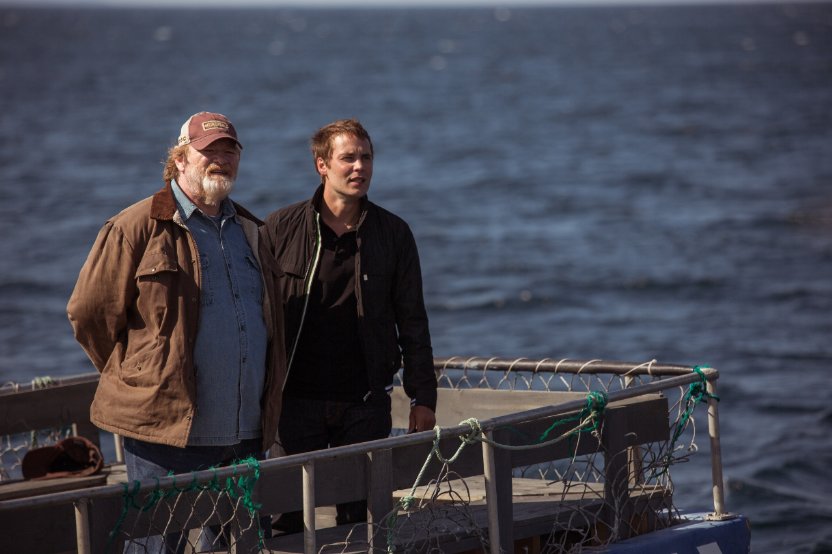
The next day, while on a visit back over to Windsor, Ontario, I noticed that the Devonshire Mall Cineplex Odeon was again offering a not-advertised-as-such Sneak Preview of a film not yet enjoying a wide US release. In this case, The Grand Seduction had been on my radar as a film spotlighting the majestic Canadian Maritime Provinces (it was filmed in Newfoundland) and offering a possibly rare starring role for character actor Brendan Gleeson, with Taylor Kitsch in a co-leading role, and a slew of Canadian actors in supporting roles, including Gordon Pinsent, who’d shown a more dramatic side in Away from Her several years ago. I didn’t realize that Pinsent is over 80 years old; he doesn’t seem it.

This film made laugh out loud and gaze with awe at the cinematic landscapes more than any other film I have seen in recent memory, but, the plot should have been simplified. Gleeson is the self-appointed mayor of a small Newfoundland coastal town falling on hard times based on lack of employment and job opportunities in general. Someone in the town, I forget who, decides that the town has an opportunity to serve as a site of a new oil and gas (or something like that) production factory. But first they have to prove they are ready to host the new factory, which is where Kitsch comes in as the young hotshot doctor that the town goes to extreme lengths to convince that he may want to stay there more than one month.

Sounds like a crowd pleaser, right? It was, but there was just TOO MUCH PLOT. Kitsch’s opening scene should have been cut, and his second scene, which does a better job of setting up his character, put in his place. Gleeson’s wife moves to the mainland for another job at the start of the film, which sets the plot in motion, but then (minor spoiler) she decides to return home at the end with what felt like the flick of a hand. Other townspeople are introduced, most notably a crafty and younger postmistress who may or may not have eyes for Kitsch, but the movie eventually becomes so overstuffed, it’s impossible to get a sense of their various character arcs. And towards the end of the film, Kitsch makes a not-quite-believable quick decision that contributes to the end of the story, but felt like a cop-out to me.

In spite of that, the movie is filmed completely on location, with the lush, green cliffs of coastal Atlantic Canada on full display, and the picturesque village coming across as a character of its own. The film’s music score makes use of charming, and regionally appropriate, fiddle music at multiple instances in the story.

So, if the viewer is game for going along with the ride, and feeling like they are part of a small coastal town where everyone knows your name, but doesn’t want to think too much about the plot (or just suspend their disbelief) this one is a great choice. Interestingly, it was originally a French – Quebec film; I can’t recall seeing an example of a Canadian company remaking a film from elsewhere in the country, although I am sure it has happened.


grand seduction

Standard
Theatre

Sudden End of an era in the South Bay Area

Today San Jose Repertory Theatre announced that it has filed for bankruptcy and will no longer produce shows or any output, immediately canceling the remainder of its season and its planned 2014-15 offerings.

Although I never made it to see a show there, I was familiar with its output as a notable producer of plays in the South Bay region. Additionally, I had worked with its now-former artistic director, Rick Lombardo, in the Boston area, and he and I actually made the move to California at the same time, though bound for different locations.

It’s a shame – and seems quite incredulous, actually – that the Rep couldn’t form an alliance with one of the deep – pocketed tech companies in the Silicon Valley area. I don’t know the whole story, of course, though it may be tied in to downtown San Jose’s ups and downs with making itself into a destination rather than just a place that people work. I applied to work there at least once between 2008 and 2011, though it was always just a little too far from my Marin County home base to go for a night. However, many regional actors based more in the central Bay Area (SF, Oakland, Berkeley) appeared there regularly in a variety of shows and roles.

There are uncomfortable parallels with a similar situation unfolding here in Ann Arbor at the moment with the city’s premiere resident theatre company, Performance Network, although in that case the organization’s board has “suspended operations” and a new business model is set to be presented to the board at their upcoming meeting next week.

And on a personal note, this news comes just as I’ve been accepted to study for an MFA at an arts management program. But I remain committed and hopeful that the power of the arts as a beacon of the community – and way for people and places to come together – will shine through.

Standard