Movies

Lose Momentum, Gain Momentum

After a strong start to the month, it’s clear that blogging was not my primary focus as the month of May went on.

BUT THAT’S OKAY.

I continued my filmgoing throughout the month with the following titles, all linked to their IMDB pages.

Only Lovers Left Alive
On My Way
X-Men: Days of Futures Past
Belle
Locke

Of those films, I would say that On My Way, with enduring French screen icon Catherine Deneuve, was the most satisfying.  Makes me want to do a European vs. American cinema post in the near future…

deneuve

Standard
Movies

Crafty Minimalism and Tense Thrills

While on a visit to West Michigan yesterday I checked out the film listings in the area. I noticed that the Celebration Cinemas in Woodland offered a wide range of what was once known as “second run” films (not sure if they still are) and was inclined to take in an encore viewing of Her, my favorite film from 2013. But once I arrived at the cinema, I saw that Blue Ruin, an indie thriller I had heard some buzz about, was also showing, and made a last – minute change of mind to take in that film instead, which proved to be a good choice.

The film offers a tense yet understated look at the “revenge thriller”, which one article about the film pointed out used to be much more common in Hollywood films (think late 90’s/early 00’s films often starring Ashley Judd) but is now less common. In this case, the minimalism is apparent right from the start when the first 20 minutes or so have nearly no dialogue, but are carried along by a crackerjack music score, character activity, and intriguing, immediate curiosity over the motivations and history of the main character, Dwight, played by Macon Blair.

Those early scenes depict Dwight living in homeless squalor in coastal “Delaware” (but shot, I believe, in Virginia Beach), with a depressed despondency. He gets word of a new development related to some tragic family history and is set off on a path of vengeance, which intersects with his sister, living a domestic life in the DC suburbs, an old friend, and members of the extended family related to those who committed the inciting act.

Yet through it all Dwight never takes on the air of the obsessed vigilante, instead staying more on the opposite end of fear and uncertainty. He can’t shoot a gun very well, and he doesn’t seem comfortably proceeding with a life geared towards violence. He might be one of the most “normal” protagonists I have ever seen in such a film, and although the movie eventually leads itself to a somewhat familiar and inevitable climax, it maintains the minimalism and character uncertainty to make it seem refreshing and unusual to the viewer. I hope the film goes on to become a cult classic and leads to greater things for those involved.

Standard
Theatre

Belated impressions of a Philadelphia premiere

There are just a few days left to catch Annapurna at Theatre Exile, and for some reason probably connected to my travel itinerary, I did not write it up here after attending the April 20 preview performance.

annapurnagal9

Actors Pearce Bunting and Catharine Slusar, pictured above, truly shine in this play, and I was very surprised to learn they had not worked together before, though they have likely crossed paths in the Philadelphia theatre community. I was interested to learn that the play premiered at San Francisco’s Magic Theatre shortly after I left the Bay Area in 2011 and also enjoyed a concurrent New York run this spring with the starry team of Megan Mullaly and Nick Offerman, as The New York Times highlighted prior to that production’s opening. Additionally, I had seen one prior production of the playwright’s work, and wish that I had seen another, and felt that this script offered a more mature and seasoned writing style than the earlier pieces.

In Philadelphia the setting is (presumably) more intimate from the bright lights of Off Broadway. Anything can happen in Theatre Exile’s versatile Studio X space, nestled in to the character – filled and city – wise South Philadelphia neighborhood. This time, the studio was evenly divided between an expansive set, designed by Thom Weaver, and the audience assembled on risers, with the stage management booth beyond that. The noticeably detailed and artfully strewn set evoked curiosity from the first moments of the play, with screen doors, a running shower and faucet, a bed, and several cabinets all contributing to the strong impression of Ulysses (Bunting) living an isolated life on a Colorado mountain.

A brief slapstick introduction, when Ulysses can’t believe that his wife Emma (Slusar) suddenly reappears after a 20 year absence and no contact whatsoever, gives way to a quick shift into a strand of mystery-based drama, as Emma’s motivations for coming to visit become more apparent, though never explicitly spelled out, and we learn more about Ulysses and his choices to live in isolation and face a terminal illness.

It sounds a little bit “movie of the week” cheesiness as I describe the plot there, but the reality of the tale was much more gripping. Aided by Joe Canuso’s tight and specific direction, the two actors subtly juggled power dynamics and held the audience’s attention through the 90 minutes or so of the play, which is not always an easy thing to do. As well, the plot continues to slowly unravel in such a way that the Big Revelation could be considered the start of a wider contemplation and reflection that continues after the lights have gone down on the show.

It was great to “touch in” again with the work of Theatre Exile, where I spent an intense two months working on A Behanding in Spokane exactly two years ago. I was happy to see a healthy audience crowd in place for that Easter Sunday matinee, with a noticeable (and welcome) diverse age range visible, and know that the play has matured even further as it moves towards a sure to be strong finish this Sunday, May 11.

Standard
Uncategorized

An appropriate addition to San Francisco culture

Just got word of this on a list serve. I wouldn’t mind joining!

Adventures in Geek Therapy  
A New Group that Engages the Wisdom of Geek Culture
Launching June 3, 2014
Tuesdays 7:00-9:00pm

What can we learn about mindfulness from Star Trek? What lessons about prejudice can be sought in Battlestar Galactica? What can Batman tell us about the potential effects of trauma on one’s identity? What can the building blocks of Minecraft teach us of coherence? How may we embrace the simple wisdom in the Tardis illusion fromDr. Who?

This highly experiential adventure group will use geek culture as both map and compass and employ drama therapy and expressive arts techniques. 

The group’s mission is:

  • To foster engagement, participation, collaboration, insight and creativity.
  • To explore identity, aspirations and personal responsibility.
  • To cultivate wisdom and tools to navigate human (and non-human) relationships and life transitions.
  • To honor non-conformity and build empathy.

Each month will bring a new theme, these will be the territories for our ongoing mission. The themes will come from Sci-Fi, Superheroes, RPGs, Midnight Movies, Comics and Technology.

We will begin with a Star Trek theme in June.

What: Weekly 2 hour group sessions to include group discussion, reflective writing, role-play, cosplay, games and art-making.

When: 7:00pm-9:00pm Tuesdays

Where: Central San Francisco Location

Cost: $40/week, payable monthly 
Enroll before May 23 – Save $40! First week FREE

About the Facilitator: Doug Ronning is a licensed Marriage & Family Therapist (MFC 51086) and Registered Drama Therapist. He is a produced screenwriter and a life long geek. 


No geek experience necessary.
All are welcome!

For more info: 415-902-5638 

Standard
Movies, Theatre

Don’t shoot her

elaine372Versatile and legendary actress Elaine Stritch first came to my attention in a somewhat unmemorable role (for her – as I learned later) in the 1997 comedy Out to Sea, part of a series of films that comedy legends Jack Lemmon and Walter Matthau made together near the end of their careers, and sadly, lives. In a classic eye roll inducing example of Hollywood casting, Stritch portrayed Dyan Cannon’s mother, even though the actresses are only 12 years apart in real life. Stritch commanded the screen in her few scenes, most notably tearing up a rug with fellow veteran Donald O’Connor to a cheesy rendition of “Sea Cruise.”

At some point in the next couple of years I became aware that Stritch is, in fact, a legendary stage actress, arguably best known for originating a role in Company by Stephen Sondheim but boasting many other accomplishments. As a theatre professional I recall noticing that her most recent Broadway appearance, starring in A Little Night Music with Bernadette Peters, was perhaps more successful than the original revival marquee pairing of Catherine Zeta – Jones and Angela Lansbury.

In the present day, Stritch has slowed down, somewhat, and departed her longtime home base of New York City for a new/old home right here in the state of Michigan, where she was born and lived until her late teen years. It seems that old age (she’s now 89) and health have caught up with her, although, on the other hand, she also seems to be a textbook study in “never say never.”

And so the documentary film Elaine Stritch: Shoot Me is making the rounds at cinemas around the country. I first heard about this film well over a year ago and found the actual experience of seeing it to be somewhat anticlimactic for that reason. I also may have been feeling some residual annoyance that I did not attend its Michigan premiere over in Birmingham last month, for which Ms. Stritch was also in attendance.

The film takes an unflinching look at Stritch’s life circa 2011 – 2012, as she continues to perform mostly in cabaret settings, struggles with problems related to the aging process, begins to tire of life in Manhattan and (somehow) maintains a resiliency that “the show must go on” – to use a cliched but true phrase. Stritch demonstrates resiliency, commitment and salty enthusiasm in all of her projects, perhaps most notably in her balance of masking her difficulty in memory into a sort of comedic act with her musical director when they are performing… to the audience’s delight.

I found the scenes where Stritch was at her most genuine to be the most appealing. These moments took the form of when she was with family members or close friends. There she was as a veteran and accomplished performer earning her accolades but also going with the flow and not getting too worked up about something not going right, a deadline or an impending decision that had to be made. It seemed those moments, with her broad and genuine smile and satisfaction, showed her at her most honest.

Ms. Stritch has been vocal about a seemingly and understandably rough transition into her life in Birmingham, but based on recent interviews it appears that things have settled down for her a bit more now, and I do hope that she’ll make a few more appearances in the metro Detroit area, which seems very honored to count her as a regional native.


Standard
Uncategorized

Personal Blog: Life in a Self Sustaining Place

Having just passed my one year anniversary of arrival in Ann Arbor, I’ve been reflecting on how life in this city is only the second time I have ever experienced living in a “self-sustaining” place – I’ll say more about what that means in a moment – and the longest time I have ever experienced such a setup in my life.

When I say “self-sustaining” town, I mean a place that fends for itself in that residents don’t have to go to a neighboring town for groceries, entertainment, school, cultural offerings, outdoor excursions, and so on and so forth. The only other time I experienced such an arrangement was with eight months living in Santa Maria, California in 2008, a place that’s even more of an outpost town in that Santa Barbara, the next major city to the south, is 75 miles southeast, while San Luis Obispo, its largest northern neighbor, is 30 miles north. And in that part of California, you can’t go any farther west, and east is an even greater distance to the next major city; for the record it is Bakersfield at 138 miles east. Admittedly there are towns in between, but those are the major landmarks.

Most of the towns I’ve lived in over the years, most notably in the North Shore region of Massachusetts along with Marin County in California, are nestled into a patchwork of towns that depend on one another in symbiotic ways. You might live in one town but work in another (or the nearest largest city) or depend on a nearby town for specific elements of your daily life, but it’s rare that you’ll stay within your own town or city limits on a daily basis.

I mention this because I notice that it is still hard for me to adjust to life in a town that fends for itself and could be fine without any interruptions to other locations (Detroit, Royal Oak, Flint, Toledo, Pontiac…) for various activities. I’ve gotten so used to depending on having offerings in other towns, and moving between said locations, that it feels weird to not be doing so. For example, yesterday – and it seems like this happens every week to 10 days – I was feeling the fishbowl bubble of life in Ann Arbor, and randomly decided to drive east to Canton and Novi for what amounted to little more than visual amusement, a good meal and some sightseeing on a fair spring day. And even though that excursion was just three hours, I came back to Ann Arbor feeling considerably more refreshed and with none of the exasperated feeling that had plagued me as I set out.

I don’t have to go to Windsor for fun, to Detroit for a show, to Royal Oak or Birmingham for a film, to the west side of the state for sightseeing, into Canadian locations for further sightseeing and cultural events… I do all this because I want to, and it is admittedly enriching.

But I might be interested to hear the opposite perspective of this setup, where someone who is accustomed to and quite content with living in a self-sustaining town goes out into the world and has to move around on a larger scale.

Standard
Uncategorized

Sassy tuneful nostalgia

I’m offering some short hot off the press impressions of an appearance this evening from singer-songwriter Cheryl Wheeler at the Ann Arbor Ark, which also functioned as a very belated first visit for me to the acclaimed local music venue.

Wheeler, who has long been a familiar presence on my family’s playlist, continues to shine in the live setting, treating the audience like old friends. However, this isn’t to say that she loses focus on the music — it seemed to be quite the opposite, as she worked very specifically from a (presumed) outline of songs from her catalog. She was quite generous in offering a range of personal anecdotes that mostly focused on East and West Coast experiences, whether walking with her wife and animals at Horseneck Beach in Massachusetts or driving the long haul from Seattle to California destinations (Petaluma and Santa Monica both got specific shootouts) and writing a song or two along the way. She expertly segued her narrative so that the last quarter or so of her concert focused solely on the music, after plenty of laughs and chat in the earlier part of the evening.

I’m pleased that Wheeler included “Driving Home” – one of my favorites of her recordings – and a few other of her older songs. She offered a subdued interpretation of “Aces”, another older tune, earlier in the evening, leading me to think she was choosing not to use her higher register, but later selections showed that range to still be in place and in excellent form.

Of course I also appreciated the strong New England feel of the concert. She even included her song “When Fall Comes to New England”, which was a frequent sight on my iPod playlist for a time, most notably during a series of driving commutes in Western Massachusetts in the summer and fall of 2007.

She got the most reaction out of the (nearly sold out) crowd before her final song, which she humorously prefaced with a “fake final” song of her fan favorite “Potato” (yes, that’s the song name) – explaining that she doesn’t like the forced tradition of the singer leaving and then being called back to the stage for “…just one more.” And so she proceeded with the most heartfelt tune of the evening (wish I knew the name) written in honor of her father’s 75th birthday.

Although some might say that Wheeler flies under the radar in her music career, she seems just fine with that and willingly capable of doing whatever she wants with her music, with a loyal and appreciative fan base that is right there cheering her on.

Standard
Movies

A weekend to … consider

The French/British film Le Week-End has continued its Ann Arbor run at the State Theater, and so I caught it there on a matinee showing yesterday.

Billed as an elder-skewing romantic comedy to US audiences (at least) the film is in fact a darker look at longstanding relationships, as seen through the eyes of veteran actors Jim Broadbent and Lindsay Duncan, both of whom impress in the central roles, and carry the film solely on their shoulders for nearly 2/3 of the running time as a long-married couple from the UK visiting Paris for their anniversary.

Broadbent offers a character that could be seen as a parallel universe sequel to his work in Another Year a couple of years ago. In the earlier film, he was happily married and ensconced in London life, but this time, he’s not so happily married (though still officially so) and reeling from some unexpected developments in his university job. I find that Broadbent has become known for an affable, twee presence in some of his more recent roles, and here, he darkens the shadings nicely, recalling some of his earlier work such as Moulin Rouge! although not as extravagantly so. Duncan captivates in her role, showing a believable mix of tenderness and abruptness, combined with questioning how much of her own feelings to let on or instinct to follow.

It’s a pity that the actors are let down by the construction of the film, which starts and ends very awkwardly and can’t decide it it wants the characters to be quirky or realistic. I think this is some combination of writer/director challenges – IMDB tells me that both of them (Hanif Kureishi and Roger Michell) have collaborated frequently, but they seem to have lost their stride with this effort. Just as an example, the film should have started about 10 minutes past when it did start, and the ending is a total “let’s throw in the towel” crapshoot.

The film does add more subtext for its last third, when the couple attends a dinner party given by a friend of Broadbent’s, played by Jeff Goldblum in a charismatic performance, and are faced with the awkward (yet familiar in a social setting) choices of putting on a show or letting their current strife show to people they barely know. The technical composition of the film is also at its most intriguing here, with moody evening shots of the Parisian skyline seeping through into the apartment and several long shots of a metal stairway emphasizing shadows and construction.

I definitely wanted to see this film do a better job of telling its story – but I’m not sure how it would have done that. Nonetheless it is refreshing to see a film carried by “older” actors and not afraid to be downbeat and take chances in how its story is unveiled.

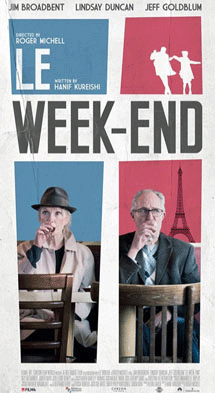
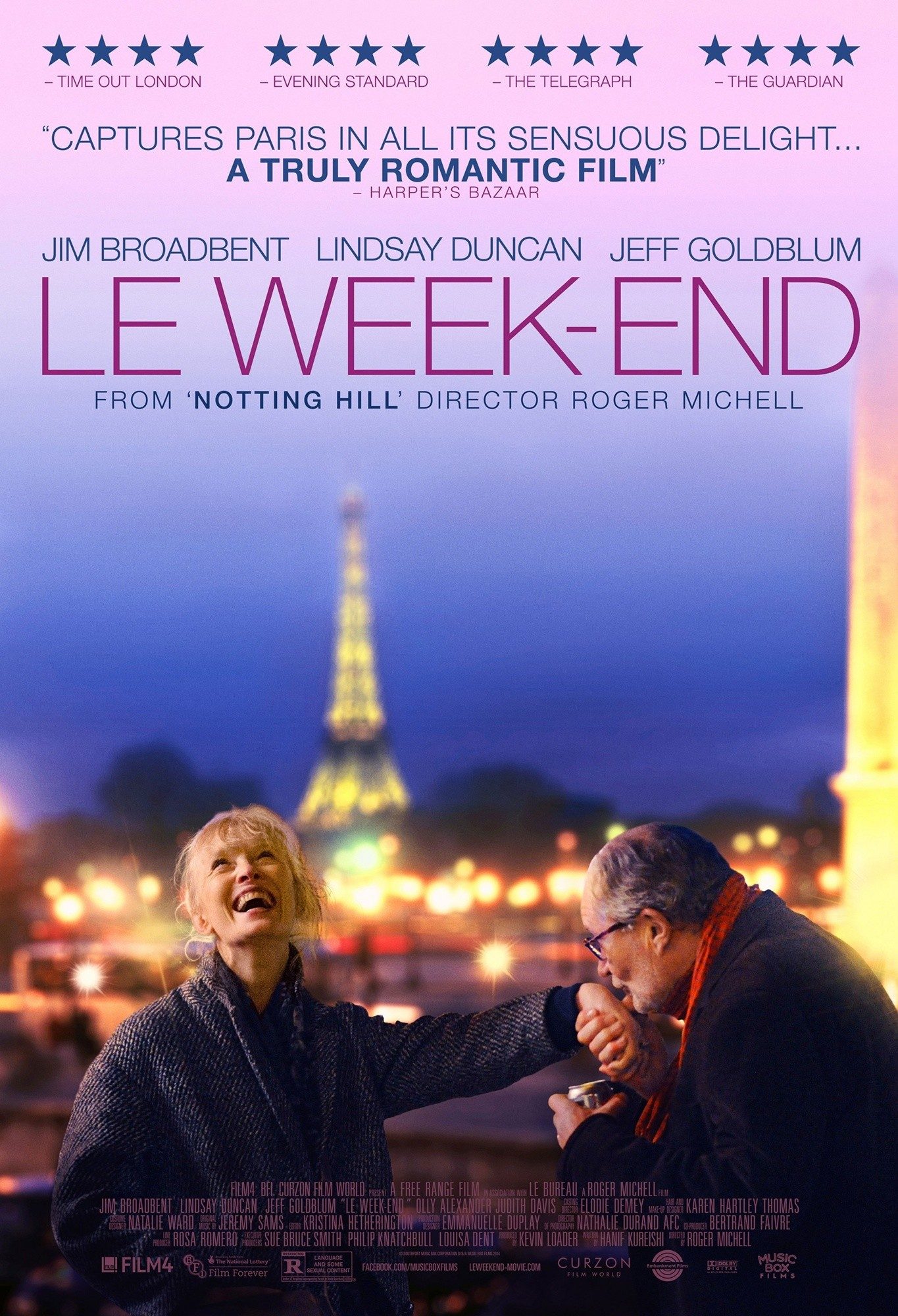
I also found that the UK and US advertising seemed to convey a slightly different interpretation of the plot as seen in pictures. Both examples are below.

le-weekend-2le-week-end-poster03

(UK on left, US on right)


Standard
Theatre

College Theatre versatility at its height

Ten years ago at this exact time of year/these exact days found me shuttling between Hampshire and Smith colleges in the Pioneer Valley of Massachusetts for a series of theatrical commitments, while also stroking anticipation for a study abroad semester to come that fall at the British American Drama Academy in London, England.

While the following two years brought greater, and perhaps more memorable, professional accomplishments in the form of directing three full length plays, writing one, producing two, acting in one, playing a key role in supervising the theatre department during my senior year, and additional high – flying theatrical activities, I feel that this particular week was the most intensive of my college theatre career, and an apex of its own.

I don’t recall the specific day by day activities, but I do clearly recall the anticipation and buildup of dually working towards two performances of a one act play I’d directed (“English Made Simple”, part of All In the Timing by David Ives) on that Thursday and Friday night, April 29 and 30, to be immediately followed by a one-off Richard Foreman devised theatre performance that Saturday afternoon, May 1, which had its final rehearsal late on the same Friday night. Simultaneous to all this was ongoing preparatory work for Hampshire’s New Play Festival the following weekend, for which I was serving as festival producer and director of two short plays.

I remember going back to my room in Mod 4 and feeling nothing but exhilaration and excitement. This was what it must be like to be on top of the theatre game. And unlike (i later learned firsthand in) the professional world where you may or may not be just a jobbing actor, this was all among friends and had a shared sense of accomplishment, creativity and collaboration. Following the successful Foreman performance, we half-jokingly wanted to take it on the road. The previous day, the Smith festival of directors (which, amusingly, featured mostly Hampshire students,)  had a slightly different, though equally appealing, feel of “this is something new and I could go somewhere with this” – where it was my first major theatre directorial experience.

It’s unfortunate that (I’ve found) college theatre experiences get somewhat downplayed after a certain point in the professional world. And, as I noted yesterday, it’s now close to a decade since my last college theatre experiences. But there’s something about that spirit of collaboration that still stands out now many years later, and I feel grateful to have reconnected with at certain times in my professional theatre career. And I wouldn’t be here in my current Ann Arbor life if I hadn’t had that particular Hampshire College – based theatre career.

So I think the impetus for this post is: be grateful for your college accomplishments. don’t forget about them. and let those memories carry you to something even more creative and exhilarating when the time is right.  

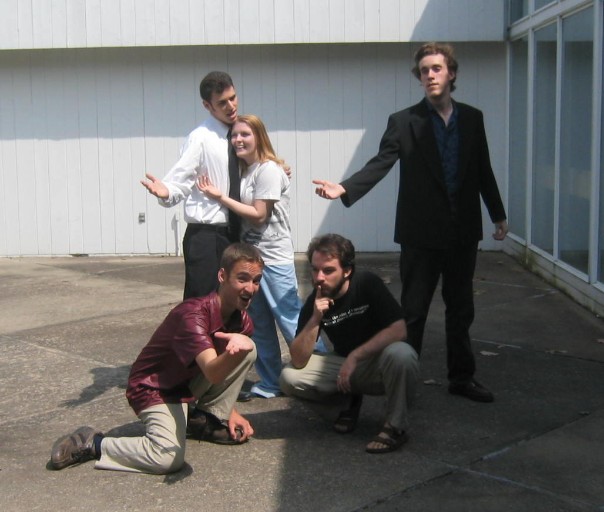
Richard Foreman performance: featuring actors myself, Russ, Abby and Nate, with our director Shawn looking pensive.

Richard Foreman performance: featuring actors myself, Russ, Abby and Nate, with our director Shawn looking pensive.

Standard
Movies

Under the Skin and into the psyche

Soooooo…. Under The Skin.

What is sure to be one of the most polarizing films of this year has gained more appreciation from me since seeing it at the State Theatre‘s late show last Friday night. It’s a perfect film for a late show, with macabre themes and plenty of unsettling imagery.

scarjo

Scarlett Johansson adds to an impressive recent repertoire of roles with this performance, The actress strips away (quite literally at times) her aura of Sex Symbolness and Appeal, taking us back to an earlier era somewhere around ten years ago when she was more known just for her performances and less for her off-screen activities. Long stretches of the film are devoted to her character being off on her own, and while Johansson does not carry the movie in as quite an assured way as elder veterans Sandra Bullock and Robert Redford (among others) did in recent films, she commits to the character and losing herself — or rather her assumed “ScarJo” self — in the storyline.

But what is the storyline, exactly? After an assured and striking Kubrick-style opening sequence, we are quickly dropped in to the outskirts of Glasgow, Scotland. Johansson’s unnamed female character is just there, with an immediate predatory orientation established. She relates to a few people, who could be considered accomplices, but their exact relationship is not clearly explained. Soon the character is on her own behind the wheel of a bulky white van and exploring the outer neighborhoods of the Glasgowegian surroundings.

At one point early in the film the woman finds herself on a beach, in a memorably unsettling sequence where she does the opposite of what a Good Samaritan might do, helping to clarify her character intent and give a hint of what might be lying ahead in the story.

It quickly becomes apparent that she’s looking for some people – namely, seemingly aimless men who “won’t be missed”, to quote other reviewers, if they don’t come home at night. This is most strikingly and unsettlingly seen in a series of late night liaisons that the woman initiates by taking men back to “her place,” but what happens after that is a bit darker than a hot mess. It’s at these moments that the film’s music score, like a modern-day Bernard Hermann scoring Hitchcock, is at its most striking and unsettling, as a theme is established for these incidents that makes it clear that the moments are important to the larger story.

I will add that those sequences – when the woman is predatory towards the man – were unsettling for me as a male viewer, as if a later point that the film makes about gender, which I won’t spoil, is foreshadowed and turned on its head.

Johansson’s character continues to explore and, seemingly, struggle to comprehend life in Glasgow and the immediate surroundings. While these sequences were possibly the most distant or unclear, narratively, of the film, they shine a rich and telling spotlight on metropolitan Scotland, reminding me (having been there in Glasgow and many other regions of the country) of its unusual combination of a brutal and invigorating quality of life, rich street culture and heightened regionalism, which is also seen in the movie in a series of incomprehensible statements, given their thick Scottish accents, from a range of people peripherally coming in and out of the main story, some of whom apparently didn’t know they were being featured in a movie or interacting with a well – known actress.

When an attempted encounter with another loner guy (who is a real individual and hopes to use his role to bring awareness to a health issue/seen and not being seen) doesn’t go as she’s planned, the woman heads north to the Scottish Highlands and the film makes a noticeable change in tone, shifting from urgency to something more … reflective. It suggests through action (dialogue is at is most minimal here) that the woman is somehow more willing and accepting to try human life at this point, as if the rejection from the other man challenged her to look at her own choices, more individually. I found this section of the film to be the most abstract and challenging to grasp, but I think it has stood out with more meaning in the days since.

I don’t know what this film means (who can, really?) but I feel appreciative of its willingness to challenge and provoke the audience in a subtle way, along with a willingness to let actions speak louder than words complimented by an atypical story.

Standard