Movies

A tasty cinematic surprise

Chef PosterThe other day I decided that I needed a close-to-end-of-week cinematic break. So I went back over to the Quality 16, my neighborhood megaplex, thinking I’d bow to crowds and go to Edge of Tomorrow. But starting at a slightly more convenient time was Chef, a movie I hadn’t heard much about but seemed to snugly fit my preferences for independent cinema.

This was a great experience of “going in cold” (not knowing much about) to the movie. I see now that the film’s trailer gives away many of the good comedic moments and provides a broad outline of the plot, which is meant to be more surprising in the film’s narrative context. But since I had not seen the trailer – or didn’t remember it – that was not a problem for me.

The movie focuses on a turning point in the life of Carl Casper (writer – director Jon Favreau) who enjoys an OK life as head chef at a swanky, but wants to be better Los Angeles restaurant. A few sharp opening scenes clearly set up the story there, where Carl seems to want to return to a professional culinary life where he can do more of what he wants, but is stymied by a controlling boss (Dustin Hoffman in a well-played and well-placed cameo role.) Meanwhile, his assistants (John Leguizamo and Bobby Canavale) still support him, and the hostess (Scarlett Johansson) seems to have eyes for him.

And then in Carl’s non-work life, he is trying to be a good example to his son, who only sees him part-time and spends the rest of the time at his mother (Sofia Vergara)’s opulent estate-style house. Carl doesn’t seem to see that his son wants more out of the relationship, but the son cleverly gains the upper hand, as only smiling 10 year olds can do, at several instances in those early scenes.

Things come to a head for Carl when a popular regional food critic (Oliver Platt) decides that he will be reviewing the restaurant. Carl and boss and associates spar over the servings for the night in question, and there are multiple lingering effects for all involved for several days afterwards.

At this point, the film introduces its most modern and surprising element: a wholehearted acknowledgement of the social media age. Carl has not kept pace with the world of Facebook, Twitter, YouTube, instant journalism and celebrity news… but everyone else around him has. He quickly learns the pros and cons of the field, and for a while I thought the movie was turning into a satire on how obsessive and compulsive these digital worlds have become, like a national obsession. The movie seems keenly aware of this option as the plot thread continues to be integrated throughout the rest of the film.

But instead, after a small helping of satire, the movie makes a left turn, and gains a warm heart. Carl’s ex points him in the direction of Miami, where all three family characters have history, and he ends up in the office of an old friend (Robert Downey Jr. in another well-placed cameo) who offers Carl the chance to take over his old food truck. With a little help from his friends and some key, warm support from his son, Carl sets off on a journey of redemption and new opportunity back to Los Angeles.

The film doesn’t end with that meeting! The story continues as Carl and friends get the truck operational and have a southern tier cross-country experience through New Orleans, Austin and points in between on their journey back to California. And there are further opportunities that appear when life in Los Angeles resumes.

The story might sound predictable in this outline, but everything is told in such a warm – hearted and also exuberant style, including an emphasis on colors in the frame, tantalizing shots of food onscreen, and the family relationships of the characters pushed to the front of the story, that this became one of the most appealing and satisfying films I have seen in some time.

Some outlets are suggesting that this film is Favreau’s own redemption or return to the indie world after a series of ups and a few downs in big – budget Hollywood filmmaking, and I could see how there might be some truth to that. But he also seems to enjoy using his increased industry cache to draw in Hoffman and Downey Jr. for winking cameos, along with an uncharacteristically dowdy Johannson willing to play a supporting role, and a luminous Vergara making the viewer feel right at home and as if they know her character.

It is clearly a familiar plot, but it’s played so well, and with insightful nods to the modern era, that the film is a breath of fresh air to the early summer movie season.

Standard
Movies

International Indies

As the summer movie season continued to rev up its engines this past weekend, I was pleased to go the other direction and take in two independent films, on opposite sides of the border.

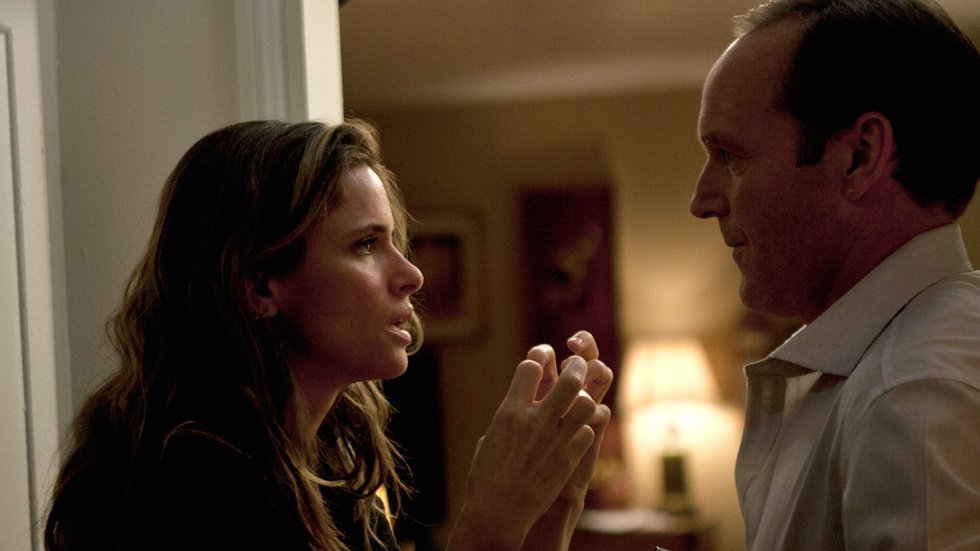
On Friday I happened to notice that Trust Me had appeared at the Quality 16. I had not heard much about this film, but a look at the cast list (written and directed by Clark Gregg, with featured roles for Amanda Peet, Allison Janney, Felicity Huffman, Sam Rockwell, and several other notable actors) showed that it might be a project of note.

Gregg wrote and directed the film, in addition to playing the lead role, and so I wondered how cathartic or personal the experience had been for him. Some scenes, most notably involving Huffman’s agent/casting supervisor character, had a strong industry bite to them, while others, mostly focused on Gregg’s own likable but awkward main character, went on for too long or did not seem well thought out.

The plot focused on Gregg’s character, a former child star turned acting coach for young actors, and his troubles fitting in to the fast – moving, changeable Hollywood system, as seen through his interactions with two primary younger clients. After meeting the second one (Saxon Sherbino) by chance, he quickly gets drawn into her and her father’s world as Hollywood outsiders, with him serving as the guide for the out-of-towners coming in from Oklahoma. Along the way, he is glad to get to know his neighbor (Peet) more intimately.

But in a sudden shift for the plot and for the film as a whole, Gregg discovers that the girl and father may not be what they seem, and spends the remainder of the movie (this is all crammed in to the last half – hour) trying to get to “the truth” and putting bis career on the line, which ultimately creates challenging and surprising results for everyone involved.

I feel like this movie had good intentions and rose above the label of “vanity project” thanks to plot and commitment of the esteemed actors. But what if the late in the film plot twist had not occurred and the story went in a different, yet still unpredictable direction? I wonder if that would have made things easier to digest or reinforced the allegorical parody style of the script. As it stood in finished form, the ending put a somewhat sour taste in my mouth, though I wasn’t completely down on the whole film.

peet and gregg

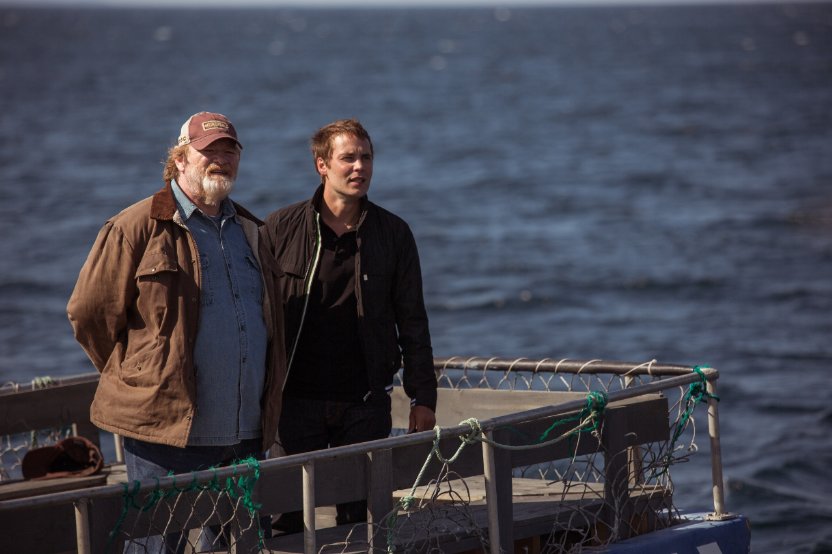
The next day, while on a visit back over to Windsor, Ontario, I noticed that the Devonshire Mall Cineplex Odeon was again offering a not-advertised-as-such Sneak Preview of a film not yet enjoying a wide US release. In this case, The Grand Seduction had been on my radar as a film spotlighting the majestic Canadian Maritime Provinces (it was filmed in Newfoundland) and offering a possibly rare starring role for character actor Brendan Gleeson, with Taylor Kitsch in a co-leading role, and a slew of Canadian actors in supporting roles, including Gordon Pinsent, who’d shown a more dramatic side in Away from Her several years ago. I didn’t realize that Pinsent is over 80 years old; he doesn’t seem it.

This film made laugh out loud and gaze with awe at the cinematic landscapes more than any other film I have seen in recent memory, but, the plot should have been simplified. Gleeson is the self-appointed mayor of a small Newfoundland coastal town falling on hard times based on lack of employment and job opportunities in general. Someone in the town, I forget who, decides that the town has an opportunity to serve as a site of a new oil and gas (or something like that) production factory. But first they have to prove they are ready to host the new factory, which is where Kitsch comes in as the young hotshot doctor that the town goes to extreme lengths to convince that he may want to stay there more than one month.

Sounds like a crowd pleaser, right? It was, but there was just TOO MUCH PLOT. Kitsch’s opening scene should have been cut, and his second scene, which does a better job of setting up his character, put in his place. Gleeson’s wife moves to the mainland for another job at the start of the film, which sets the plot in motion, but then (minor spoiler) she decides to return home at the end with what felt like the flick of a hand. Other townspeople are introduced, most notably a crafty and younger postmistress who may or may not have eyes for Kitsch, but the movie eventually becomes so overstuffed, it’s impossible to get a sense of their various character arcs. And towards the end of the film, Kitsch makes a not-quite-believable quick decision that contributes to the end of the story, but felt like a cop-out to me.

In spite of that, the movie is filmed completely on location, with the lush, green cliffs of coastal Atlantic Canada on full display, and the picturesque village coming across as a character of its own. The film’s music score makes use of charming, and regionally appropriate, fiddle music at multiple instances in the story.

So, if the viewer is game for going along with the ride, and feeling like they are part of a small coastal town where everyone knows your name, but doesn’t want to think too much about the plot (or just suspend their disbelief) this one is a great choice. Interestingly, it was originally a French – Quebec film; I can’t recall seeing an example of a Canadian company remaking a film from elsewhere in the country, although I am sure it has happened.


grand seduction

Standard
Movies

Lose Momentum, Gain Momentum

After a strong start to the month, it’s clear that blogging was not my primary focus as the month of May went on.

BUT THAT’S OKAY.

I continued my filmgoing throughout the month with the following titles, all linked to their IMDB pages.

Only Lovers Left Alive
On My Way
X-Men: Days of Futures Past
Belle
Locke

Of those films, I would say that On My Way, with enduring French screen icon Catherine Deneuve, was the most satisfying.  Makes me want to do a European vs. American cinema post in the near future…

deneuve

Standard
Movies

Crafty Minimalism and Tense Thrills

While on a visit to West Michigan yesterday I checked out the film listings in the area. I noticed that the Celebration Cinemas in Woodland offered a wide range of what was once known as “second run” films (not sure if they still are) and was inclined to take in an encore viewing of Her, my favorite film from 2013. But once I arrived at the cinema, I saw that Blue Ruin, an indie thriller I had heard some buzz about, was also showing, and made a last – minute change of mind to take in that film instead, which proved to be a good choice.

The film offers a tense yet understated look at the “revenge thriller”, which one article about the film pointed out used to be much more common in Hollywood films (think late 90’s/early 00’s films often starring Ashley Judd) but is now less common. In this case, the minimalism is apparent right from the start when the first 20 minutes or so have nearly no dialogue, but are carried along by a crackerjack music score, character activity, and intriguing, immediate curiosity over the motivations and history of the main character, Dwight, played by Macon Blair.

Those early scenes depict Dwight living in homeless squalor in coastal “Delaware” (but shot, I believe, in Virginia Beach), with a depressed despondency. He gets word of a new development related to some tragic family history and is set off on a path of vengeance, which intersects with his sister, living a domestic life in the DC suburbs, an old friend, and members of the extended family related to those who committed the inciting act.

Yet through it all Dwight never takes on the air of the obsessed vigilante, instead staying more on the opposite end of fear and uncertainty. He can’t shoot a gun very well, and he doesn’t seem comfortably proceeding with a life geared towards violence. He might be one of the most “normal” protagonists I have ever seen in such a film, and although the movie eventually leads itself to a somewhat familiar and inevitable climax, it maintains the minimalism and character uncertainty to make it seem refreshing and unusual to the viewer. I hope the film goes on to become a cult classic and leads to greater things for those involved.

Standard
Movies, Theatre

Don’t shoot her

elaine372Versatile and legendary actress Elaine Stritch first came to my attention in a somewhat unmemorable role (for her – as I learned later) in the 1997 comedy Out to Sea, part of a series of films that comedy legends Jack Lemmon and Walter Matthau made together near the end of their careers, and sadly, lives. In a classic eye roll inducing example of Hollywood casting, Stritch portrayed Dyan Cannon’s mother, even though the actresses are only 12 years apart in real life. Stritch commanded the screen in her few scenes, most notably tearing up a rug with fellow veteran Donald O’Connor to a cheesy rendition of “Sea Cruise.”

At some point in the next couple of years I became aware that Stritch is, in fact, a legendary stage actress, arguably best known for originating a role in Company by Stephen Sondheim but boasting many other accomplishments. As a theatre professional I recall noticing that her most recent Broadway appearance, starring in A Little Night Music with Bernadette Peters, was perhaps more successful than the original revival marquee pairing of Catherine Zeta – Jones and Angela Lansbury.

In the present day, Stritch has slowed down, somewhat, and departed her longtime home base of New York City for a new/old home right here in the state of Michigan, where she was born and lived until her late teen years. It seems that old age (she’s now 89) and health have caught up with her, although, on the other hand, she also seems to be a textbook study in “never say never.”

And so the documentary film Elaine Stritch: Shoot Me is making the rounds at cinemas around the country. I first heard about this film well over a year ago and found the actual experience of seeing it to be somewhat anticlimactic for that reason. I also may have been feeling some residual annoyance that I did not attend its Michigan premiere over in Birmingham last month, for which Ms. Stritch was also in attendance.

The film takes an unflinching look at Stritch’s life circa 2011 – 2012, as she continues to perform mostly in cabaret settings, struggles with problems related to the aging process, begins to tire of life in Manhattan and (somehow) maintains a resiliency that “the show must go on” – to use a cliched but true phrase. Stritch demonstrates resiliency, commitment and salty enthusiasm in all of her projects, perhaps most notably in her balance of masking her difficulty in memory into a sort of comedic act with her musical director when they are performing… to the audience’s delight.

I found the scenes where Stritch was at her most genuine to be the most appealing. These moments took the form of when she was with family members or close friends. There she was as a veteran and accomplished performer earning her accolades but also going with the flow and not getting too worked up about something not going right, a deadline or an impending decision that had to be made. It seemed those moments, with her broad and genuine smile and satisfaction, showed her at her most honest.

Ms. Stritch has been vocal about a seemingly and understandably rough transition into her life in Birmingham, but based on recent interviews it appears that things have settled down for her a bit more now, and I do hope that she’ll make a few more appearances in the metro Detroit area, which seems very honored to count her as a regional native.


Standard
Movies

A weekend to … consider

The French/British film Le Week-End has continued its Ann Arbor run at the State Theater, and so I caught it there on a matinee showing yesterday.

Billed as an elder-skewing romantic comedy to US audiences (at least) the film is in fact a darker look at longstanding relationships, as seen through the eyes of veteran actors Jim Broadbent and Lindsay Duncan, both of whom impress in the central roles, and carry the film solely on their shoulders for nearly 2/3 of the running time as a long-married couple from the UK visiting Paris for their anniversary.

Broadbent offers a character that could be seen as a parallel universe sequel to his work in Another Year a couple of years ago. In the earlier film, he was happily married and ensconced in London life, but this time, he’s not so happily married (though still officially so) and reeling from some unexpected developments in his university job. I find that Broadbent has become known for an affable, twee presence in some of his more recent roles, and here, he darkens the shadings nicely, recalling some of his earlier work such as Moulin Rouge! although not as extravagantly so. Duncan captivates in her role, showing a believable mix of tenderness and abruptness, combined with questioning how much of her own feelings to let on or instinct to follow.

It’s a pity that the actors are let down by the construction of the film, which starts and ends very awkwardly and can’t decide it it wants the characters to be quirky or realistic. I think this is some combination of writer/director challenges – IMDB tells me that both of them (Hanif Kureishi and Roger Michell) have collaborated frequently, but they seem to have lost their stride with this effort. Just as an example, the film should have started about 10 minutes past when it did start, and the ending is a total “let’s throw in the towel” crapshoot.

The film does add more subtext for its last third, when the couple attends a dinner party given by a friend of Broadbent’s, played by Jeff Goldblum in a charismatic performance, and are faced with the awkward (yet familiar in a social setting) choices of putting on a show or letting their current strife show to people they barely know. The technical composition of the film is also at its most intriguing here, with moody evening shots of the Parisian skyline seeping through into the apartment and several long shots of a metal stairway emphasizing shadows and construction.

I definitely wanted to see this film do a better job of telling its story – but I’m not sure how it would have done that. Nonetheless it is refreshing to see a film carried by “older” actors and not afraid to be downbeat and take chances in how its story is unveiled.

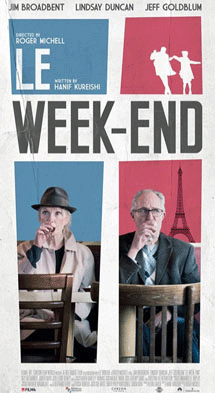
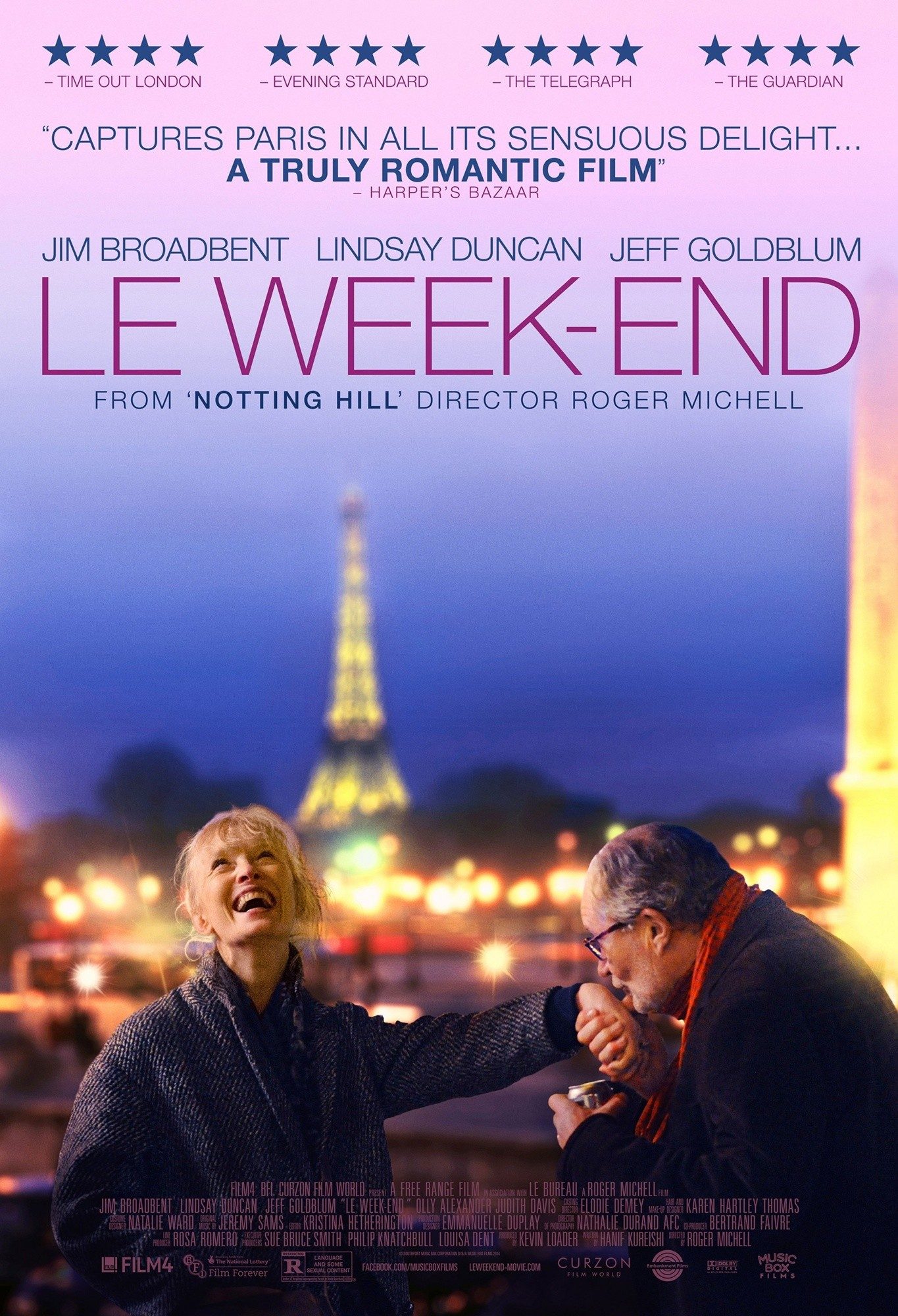
I also found that the UK and US advertising seemed to convey a slightly different interpretation of the plot as seen in pictures. Both examples are below.

le-weekend-2le-week-end-poster03

(UK on left, US on right)


Standard
Movies

Under the Skin and into the psyche

Soooooo…. Under The Skin.

What is sure to be one of the most polarizing films of this year has gained more appreciation from me since seeing it at the State Theatre‘s late show last Friday night. It’s a perfect film for a late show, with macabre themes and plenty of unsettling imagery.

scarjo

Scarlett Johansson adds to an impressive recent repertoire of roles with this performance, The actress strips away (quite literally at times) her aura of Sex Symbolness and Appeal, taking us back to an earlier era somewhere around ten years ago when she was more known just for her performances and less for her off-screen activities. Long stretches of the film are devoted to her character being off on her own, and while Johansson does not carry the movie in as quite an assured way as elder veterans Sandra Bullock and Robert Redford (among others) did in recent films, she commits to the character and losing herself — or rather her assumed “ScarJo” self — in the storyline.

But what is the storyline, exactly? After an assured and striking Kubrick-style opening sequence, we are quickly dropped in to the outskirts of Glasgow, Scotland. Johansson’s unnamed female character is just there, with an immediate predatory orientation established. She relates to a few people, who could be considered accomplices, but their exact relationship is not clearly explained. Soon the character is on her own behind the wheel of a bulky white van and exploring the outer neighborhoods of the Glasgowegian surroundings.

At one point early in the film the woman finds herself on a beach, in a memorably unsettling sequence where she does the opposite of what a Good Samaritan might do, helping to clarify her character intent and give a hint of what might be lying ahead in the story.

It quickly becomes apparent that she’s looking for some people – namely, seemingly aimless men who “won’t be missed”, to quote other reviewers, if they don’t come home at night. This is most strikingly and unsettlingly seen in a series of late night liaisons that the woman initiates by taking men back to “her place,” but what happens after that is a bit darker than a hot mess. It’s at these moments that the film’s music score, like a modern-day Bernard Hermann scoring Hitchcock, is at its most striking and unsettling, as a theme is established for these incidents that makes it clear that the moments are important to the larger story.

I will add that those sequences – when the woman is predatory towards the man – were unsettling for me as a male viewer, as if a later point that the film makes about gender, which I won’t spoil, is foreshadowed and turned on its head.

Johansson’s character continues to explore and, seemingly, struggle to comprehend life in Glasgow and the immediate surroundings. While these sequences were possibly the most distant or unclear, narratively, of the film, they shine a rich and telling spotlight on metropolitan Scotland, reminding me (having been there in Glasgow and many other regions of the country) of its unusual combination of a brutal and invigorating quality of life, rich street culture and heightened regionalism, which is also seen in the movie in a series of incomprehensible statements, given their thick Scottish accents, from a range of people peripherally coming in and out of the main story, some of whom apparently didn’t know they were being featured in a movie or interacting with a well – known actress.

When an attempted encounter with another loner guy (who is a real individual and hopes to use his role to bring awareness to a health issue/seen and not being seen) doesn’t go as she’s planned, the woman heads north to the Scottish Highlands and the film makes a noticeable change in tone, shifting from urgency to something more … reflective. It suggests through action (dialogue is at is most minimal here) that the woman is somehow more willing and accepting to try human life at this point, as if the rejection from the other man challenged her to look at her own choices, more individually. I found this section of the film to be the most abstract and challenging to grasp, but I think it has stood out with more meaning in the days since.

I don’t know what this film means (who can, really?) but I feel appreciative of its willingness to challenge and provoke the audience in a subtle way, along with a willingness to let actions speak louder than words complimented by an atypical story.

Standard
Movies

The shadow of the pearl earring

firth johannsonThis weekend I had the opportunity to see current cinematic work from onetime costars Colin Firth and Scarlett Johansson (again) – pictured at left while they were promoting their film Girl with a Pearl Earring in 2003, with Johansson looking noticeably younger – she was only 19 at the time!

While I saw Johansson’s latest film Under The Skin first, followed by Gambit with Firth, I’ll discuss them in opposite order, as I feel there is more to say about Under The Skin.

So, Gambit. Umm… not quite sure why I caught this one, aside from it being one of three films that were all showing at the Birmingham 8 last night that I was interested in, and I arrived too late for the other two…so I found myself in Cinema Two sitting down for a British comedy, written by the Coen Brothers.

Firth, who seems to have had a case of “I’ve won the Oscar, now what?/how do I live up to these high expectations?” (IMO) over the past few years, stars as Harry Deen, a meek art curator in London who, with an elder colleague (Tom Courtneay) comes up with a high – concept scheme to dupe his boss (Alan Rickman) into believing a piece of fake art is real. They decide that their plan will have to work with the cooperation of a frothy Texas belle (Cameron Diaz…) who comes to London after their initial legwork – and the stage is set from there. Among the featured actors, the film also includes supporting work from Stanley Tucci, doing a slight variation on his Devil Wears Prada character that generated a career renaissance, several Japanese actors, and a bizarre cameo from veteran actress Cloris Leachman.

Given this level of talent, why is this film receiving a tiny US release 18 months after it premiered in the UK? I can’t give specific reasons here, but I’m sure that the film did not turn out the way the producers might have been hoping for. It seems an oddly difficult sell, in that it’s supposed to take place in the modern era but clearly wears its 1960s origins (from the original movie) on its sleeve, and Diaz and Firth don’t really gel well as an onscreen couple.

To confound matters further, Firth’s “good guy” plot proves to be less interesting than the angle afforded to Rickman’s character, and Rickman chews up the screen in a portrayal not that far away from his real self, based on how I observed him on one memorable instance at a London theatre in 2004, which would be a great blog entry sometime.

Once her character is allowed to calm down, Diaz acquits herself solidly, though I found it hard to shake the seeming incongruity of seeing her very American presence alongside two very British actors.

Everything comes to a head in the film’s best sequence, an extended interlude at London’s Savoy Hotel (where I once attended a terrible yet oddly memorable theatre performance that would also be worth a blog entry) where all the characters collide and engage in the most heightened forms of physical and situational comedy. British actress Selina Cadell, who taught some of my classmates in our London theatre acting program, also appears in this part of the film.

I haven’t mentioned the Coen brothers contributing to the script – and they are the sole credited screenwriters – and I guess I felt that the dialogue was sharp, but not stupendous, and especially with their high profile involvement I wonder why they are not saying more about the project.

This may well be a case of more intrigue existing behind the scenes than what the audience sees in the finished product. I’d say it’s highly likely that the film will quickly appear in DVD bins as if it just floated there. But the film’s Wikipedia page gives some insight into its troubled production history, and while the actors probably won’t say much (if anything) about it, I’m sure it will take its place as a curious career anomaly for Firth, Diaz and Rickman.

_____________

I think I’ll save a post on Under the Skin until tomorrow….


Standard
Movies

Popcorn season returns but the candy is still present

I returned to the Michigan Theatre this evening to catch Annette Bening (who defines selectivity in her screen roles) and Ed Harris (who is a hard working actor and manages to project commitment into every part) in a new film called The Face of Love. It was great to see those two pros working together (had they appeared onscreen together before?) but the film had its pros and cons, and was somewhat overwhelmed by a larger gloss of an ultra contemporary Los Angeles/Southern Pacific Coast setting.

Bening stars as Nikki, an LA-based “house dresser” (or something like that – we only get one scene to see what she does for work…) who has lost her husband of many years (Harris) in an ocean accident during an anniversary trip to Mexico. The film flashes forward several years, and, by chance, Nikki encounters a new man, Tom (also Harris) who, naturally, looks exactly like her late husband. Nikki puts on her sleuthing hat to find more about him, ultimately tracking him down as an art instructor at Occidental College, and the two develop a connection initially as teacher-student that quickly turns to a more romantic vein. However, Nikki choses to conceal the similarity between Tom and her deceased husband, also leading her to conceal the new man’s identity from an inquisitive neighbor (Robin Williams, of all people…) and her 20-something daughter who is in and out of the house and LA area.

face of loveI really appreciated this film’s premise, and found that there were flashes of insight both from a psychological standpoint (how long does it take a widow or survivor to move on from loss? do they ever move on?) and a more character-based standpoint (will she tell him the truth? what are these characters doing in their self-contained Los Angeles worlds?)

But then the film missed several opportunities to take the story in a deeper or surprising direction; several reviews note that Tom looks up Nikki on the internet, but somehow fails to come across an obituary for her husband. And she actually drops a hint of the details she is leaving out in an early scene in their budding relationship — but both characters forget to follow up on it, leading to an inevitable confrontation sequence later in the film.

In fact, that sequence near the end of the film takes the characters back to the “scene of the crime/incident” in Mexico (kind of a spoiler but whatever) and at that point the film toyed with becoming a female-led version of Vertigo, with Bening doing her best impression of a more amicable and feminine Jimmy Stewart. I wish that the script had gone one step further (again) with a coda in that sequence, which presented an opportunity to make it all much more fantastical, similar to something like… Vanilla Sky or anything by Pedro Almodovar… but it went for the conventional, and then skipped ahead for an affecting though too rushed resolution to the story.

Clearly this film struck a chord with my thoughts and analysis, probably tied in with my psychology background. And despite the unevenness of the material, Bening and Harris offer committed performances (Bening more so) throughout the film. It sure was weird seeing Robin Williams in a dramatic supporting role (I can’t remember the last time I did) and his character appeared underused, as if he had more scenes but they might have been cut down. The film makes excellent use of a variety of Los Angeles locations but they veer on the edge of a modern design catalog and sometimes distract from the story.

___________________

I didn’t write about last week’s viewing of Captain America: The Winter Soldier back at the Quality 16. This film has started the summer movie season (hence my “popcorn season” post title) earlier than ever before, and has been well covered in other outlets as it continues the ongoing saga of the Marvel Universe.

So instead of offering a full review I’ll just note that I especially enjoyed the interplay between Chris Evans as the eponymous captain and Scarlett Johansson as the Black Widow. The two of them should clearly set off on their own series of movies rife with international intrigue, hot sexual tension and fearless crime fighting. I’m sure a lot of fans would line right up.

America

Standard
Movies

The Muppets pass by The Grand Budapest Hotel

Attempting to round up two recent films in this entry with a certain combination of brevity and detail.

As a lifelong Muppets fan I was eager to catch their latest romp Muppets Most Wanted. While the central casting (Ricky Gervais et al) seemed to hint that it might be a lesser entry in the series, the gang has an undeniably enduring charm. And their camaraderie shined in this escapade. It borrowed liberally from The Great Muppet Caper, and seemed to veer between homage and copying plot elements of previous Muppet films, but it’s hard to fault the lovable characters for that — and they are clearly enjoying their “comeback” in popular culture.

I did feel that the writers made the central plot conceit (the rest of the gang does not recognize Kermit after he is kidnapped/swapped out for an evil frog lookalike) slightly disingenuous to the history of the series and emphasis on teamwork/working with your friends … surely those that have known Kermit so long would know other ways to recognize him? As well, the task of recognition oddly fell to the “new” character, Walter, who I feel continued to get too much screen time at the expense of some of the other more established characters… but I know those are adult-minded criticisms for a film designed for a younger audience.

It seems that the film also lacked the transcending/moving/timeless elements of the Muppets, such as the iconic Rainbow Connection, countless scenes from the Great Muppet Caper (my personal favorite of the films) and the arc of the gang conquering Broadway in The Muppets Take Manhattan, not to forget the numerous guests and gags that came fast and furious during The Muppet Show days. While I ultimately enjoyed the film (and it was a great payoff for an exceedingly stressful Wednesday), I’m having a hard time remembering key standout moments as I write this commentary 10 days later.

I decided that today would bring a visit to The Grand Budapest Hotel, the current art house film of choice from inimitable (and well on his way to becoming – if not there already) iconic filmmaker Wes Anderson. While this film is showing (on both screens!) at Ann Arbor’s downtown State Theater, I changed it up and incorporated it into a visit to western Oakland County and Novi’s Emagine complex, since it was an appealing early spring day and it was good to get out of the Ann Arbor fishbowl. I’d also heard good things about the Emagine chain, but somehow had not been there yet. They definitely are the large scale complex that needs to exist in 2014, with a spacious but not cavernous interior complete with beer and wine offerings (!), well thought out design of the complex, and a reasonable $6 matinee admission price.

Ralph Fiennes refreshingly loosens up in the central role of Gustave H., the head concierge of the massive Grand Budapest Hotel somewhere in Europe. He’s joined by a typical for Anderson large group of supporting players, including — in no particular order — Edward Norton, Willem Dafoe, Adrien Brody, Saoirse Ronan, Bill Murray, Jude Law, F. Murray Abraham, an unrecognizable Tilda Swinton, Jeff Goldblum (who seems to have been off screens for some time) and many others.

While the title emphasis on the hotel suggests that the movie is going to be a situation comedy set there, the hotel itself is really the central character and launching point for the rest of the plot. I enjoyed how the film often took an unexpected old-school James Bond style air of intrigue as a mystery plot is hatched involving Fiennes and other characters. As often happens with other Anderson films (IMO), the premise may not live up to the payoff, plot-wise, but the journey getting there is so appealing (design, framing of shots, performances, overall production values, and so on and so forth) that it makes the experience worth the effort along the way.

Standard